

Table of Contents
- What Is Omega-7?
- Omega-7 vs Omega-3, 6, and 9: Where It Fits
- Omega-7 Benefits: What the Research Actually Shows
- Skin Health and Elasticity
- Mucosal Integrity
- Metabolic Function
- Cardiovascular Support
- Omega-7 Foods: Where to Actually Find It
- Sea Buckthorn Omega-7: Why It’s the Best Natural Source
- 8848 Herbs and the Himalayan Omega-7 Advantage
- The Bottom Line
- FAQs
Quick Summary
Omega-7 (palmitoleic acid) is a monounsaturated fatty acid naturally found in foods such as sea buckthorn, macadamia nuts, fatty fish, and full-fat dairy. Unlike omega-3 and omega-6, omega-7 is non-essential because the body can produce it in small amounts. Research has explored omega-7 benefits for skin hydration and elasticity, mucosal health, metabolic function, and cardiovascular markers. Among natural sources, sea buckthorn is particularly rich in omega-7, while also providing vitamin C, carotenoids, vitamin E, omega-3, omega-6, and omega-9. This guide explains what omega-7 does, where to find it, and how sea buckthorn compares with isolated omega-7 supplements.
You’ve heard of omega-3. You probably know omega-6 exists. But omega-7 benefits barely get mentioned, and that’s a problem, because this fatty acid does things the others don’t.
Omega-7 is rare in the food supply. Most people eating a normal diet get almost none of it. Yet it plays a specific, well-studied role in skin health, mucosal integrity, metabolic function, and cardiovascular support that no other fatty acid covers in the same way.
Here’s what it is, what it actually does, and where to find it in meaningful amounts.
What Is Omega-7?
Omega-7 is a monounsaturated fatty acid. Its primary form is palmitoleic acid (16:1n-7). Unlike omega-3 and omega-6, which are polyunsaturated and classified as essential fatty acids, meaning the body can’t produce them and must get them from food. Therefore, omega-7 is technically non-essential because the body can synthesise small amounts of it.
But “non-essential” in biochemical terminology doesn’t mean unimportant. It means the body can make some. It doesn’t mean the body makes enough, or that dietary intake doesn’t matter.
Omega-7 is naturally present in human skin tissue. It’s a structural component of sebum, the skin’s natural oil, and plays a direct role in maintaining the integrity of skin cell membranes and mucosal linings throughout the body. The fact that it’s endogenous to skin tissue is part of why research on dietary omega-7 intake and skin health keeps producing interesting results.
Omega-7 vs Omega-3, 6, and 9: Where It Fits
To understand where omega-7 sits, it helps to see the full picture quickly.
Omega-3 (alpha-linolenic acid, EPA, DHA): polyunsaturated, essential, primarily associated with cardiovascular health, brain function, and systemic anti-inflammatory activity. Found in fatty fish, flaxseed, walnuts.
Omega-6 (linoleic acid, arachidonic acid): polyunsaturated, essential, involved in immune function and inflammatory signalling. Found widely in vegetable oils, nuts, seeds. Most Western diets have too much omega-6 relative to omega-3.
Omega-9 (oleic acid): monounsaturated, non-essential, the primary fatty acid in olive oil. Associated with cardiovascular health and anti-inflammatory activity. The most abundant monounsaturated fat in most diets.
Omega-7 (palmitoleic acid): monounsaturated, non-essential but functionally specific. The rarest of the four in the food supply, associated with skin health, mucosal support, metabolic signalling, and cardiovascular function. This is the one most people are consistently low on without even knowing it.
The omega-3, 6, 7, 9 benefits framework matters because these fatty acids work together and influence each other’s metabolism. But omega-7 is the one the others don’t substitute for; i.e. its specific molecular structure gives it a distinct biological role.
Omega-7 Benefits: What the Research Actually Shows
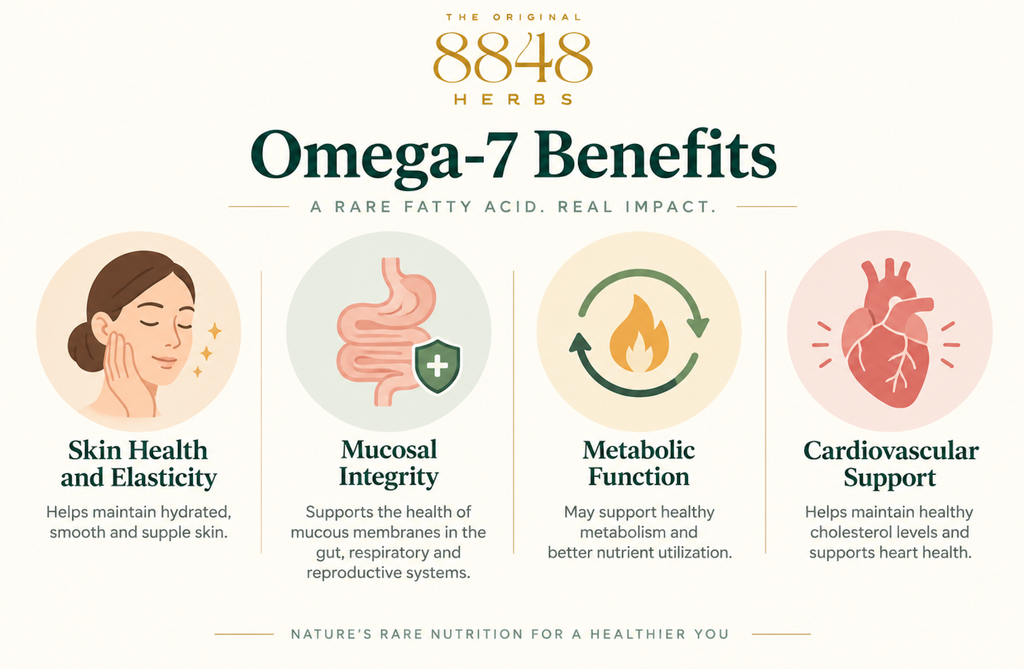
Skin Health and Elasticity
This is the most studied application of omega-7, and the research basis is solid.
Palmitoleic acid is a natural component of human skin tissue and sebum. As we age, endogenous production of omega-7 decreases, which is associated with reduced skin elasticity, increased dryness, and slower wound healing. Dietary intake of omega-7 has been studied as a way to support what the body produces less of over time.
Research has pointed out omega-7 supplementation in the context of skin hydration, elasticity, and the support of skin barrier function. The results consistently point toward meaningful benefits, particularly for dry skin, age-related skin changes, and mucosal dryness, including vaginal dryness in postmenopausal women, which is one of the more specific and well-documented clinical applications of omega-7 research.
Mucosal Integrity
Beyond skin, omega-7 plays a role in maintaining the mucosal linings throughout the body: the digestive tract, respiratory tract, and urogenital system. Mucous membranes require adequate fatty acid supply to maintain their barrier function and moisture levels.
This is why sea buckthorn omega-7 has been studied in the context of digestive health, dry eye syndrome, and mucosal support more broadly. The fatty acid’s role in membrane integrity isn’t limited to external skin; it extends to every mucosal surface in the body.
Metabolic Function
Some of the more recent and interesting research on omega-7 focuses on its role as a lipokine, a fatty acid that functions as a signalling molecule in metabolic regulation.
Studies have looked at palmitoleic acid’s potential role in supporting healthy insulin sensitivity and lipid metabolism. Some research suggests it may help reduce triglyceride levels and support healthier blood lipid profiles. This is still an active area of research rather than established clinical guidance, but the mechanistic basis is credible and the early data is promising.
Cardiovascular Support
Omega-7 has been studied for its potential role in reducing C-reactive protein (CRP), a marker of systemic inflammation associated with cardiovascular risk. Some clinical trials have shown reductions in CRP with omega-7 supplementation alongside improvements in LDL particle size, i.e. larger LDL particles are associated with lower cardiovascular risk than small, dense LDL.
Again, this is promising rather than conclusively established. But the cardiovascular research on omega-7 is more developed than most people realize, and it adds to the case for dietary intake beyond skin health alone.
Omega-7 Foods: Where to Actually Find It
Here’s the honest answer: omega-7 is genuinely rare in common foods. That’s not a supplement industry line but why most people are consistently low on it without any obvious dietary gap.
Macadamia nuts are the most accessible whole food source. They contain palmitoleic acid in meaningful amounts, say roughly 17–22% of their fat content. But macadamia nuts are calorie-dense and expensive, and you’d need to eat them daily in reasonable quantities to get consistent omega-7 intake.
Fatty fish, particularly anchovies, salmon, and sardines, contain some omega-7 alongside their omega-3 content. The omega-7 content is secondary and varies significantly depending on the fish’s own diet.
Full-fat dairy from grass-fed animals contains small amounts of palmitoleic acid. Not a concentrated source, but a contributor in diets that include it.
Sea buckthorn is in a different category entirely. It’s the most concentrated plant source of omega-7 known, and the primary reason why sea buckthorn has attracted serious nutritional research interest beyond its vitamin C content.
Sea Buckthorn Omega-7: Why It’s the Best Natural Source
Sea buckthorn pulp oil contains palmitoleic acid at concentrations ranging from 19% to 29% of the total fatty acid content, depending on variety and growing conditions. No common food source comes close to that concentration in a plant-based form.
This is what makes the omega-7 supplement vs sea buckthorn comparison worth having directly.
Most omega-7 supplements on the market are either derived from sea buckthorn oil or from purified fish oil fractions. The supplement form offers a concentrated, standardised dose in a convenient format. Sea buckthorn in whole juice or pulp form delivers omega-7 alongside the full nutritional matrix of the berry, viz., vitamin C, carotenoids, vitamin E, omega-3, omega-6, omega-9, polyphenols, and minerals, all of which work synergistically.
The synergy matters. Vitamin C and vitamin E work together as antioxidants. Carotenoids complement the skin-health benefits of omega-7. The full fatty acid spectrum of omega-3, 6, 7, and 9 together provides a more complete lipid profile than omega-7 in isolation.
For most people, whole sea buckthorn in a quality juice or oil form is a better daily input than an isolated omega-7 supplement, because you’re getting the fatty acid in its natural nutritional context rather than stripped out of it.
Himalayan sea buckthorn harvested from the extreme altitudes, intense UV exposure, and thermal stress of Ladakh develops far higher fatty acid concentrations than lowland crops; a direct result of the plant adaptation biology inherent to true Himalayan sourcing.
8848 Herbs and the Himalayan Omega-7 Advantage
8848 Herbs sources sea buckthorn from the wild high-altitude landscapes of the Himalayas, the environment that produces the fatty acid density that makes the ingredient worth taking seriously.
The best source of omega-7 isn’t a synthetic isolate manufactured in a lab. It’s a berry that has spent thousands of years adapting to one of the harshest growing environments on the planet, producing concentrated protective compounds as a survival response and delivering those compounds to you in a form your body recognises and uses.
That’s the 8848 sourcing philosophy. Wild-harvested, high-altitude, minimally processed, so the omega-7 and everything surrounding it in the berry arrives intact.
The Bottom Line
Omega-7 benefits are real, specific, and distinct from what omega-3, 6, or 9 provide. It’s the fatty acid your diet is most likely missing, not because you’re eating badly, but because it’s genuinely rare in the standard food supply.
Sea buckthorn is the best natural source of omega-7 by a significant margin. And Himalayan sea buckthorn, sourced from the high-altitude conditions that drive fatty acid concentration in the plant, is the highest quality form of that source.
If you’re covering your omega-3s and still wondering why certain gaps in skin health, mucosal function, or metabolic markers aren’t closing, then omega-7 is worth a serious look.
FAQs
How much omega-7 do I actually need per day?
There’s no established RDA for omega-7 since it’s classified as non-essential. Research trials have typically used doses of 210 to 420 mg of palmitoleic acid per day. A quality sea buckthorn juice or oil product consumed daily at the recommended serving size generally falls within this range.
Can I get enough omega-7 from food alone?
Technically possible if you eat macadamia nuts and fatty fish regularly, but practically difficult to achieve consistently. Sea buckthorn is the most efficient whole-food route to meaningful daily omega-7 intake.
Is sea buckthorn omega-7 better than a supplement?
For most people, yes, because whole sea buckthorn delivers omega-7 alongside synergistic nutrients that isolated supplements don’t include. The exception is someone who needs a very precise, standardised dose for a specific clinical reason.
Who benefits most from increasing omega-7 intake?
People dealing with dry skin, reduced skin elasticity, dry eyes, digestive mucosal issues, or those looking to support metabolic and cardiovascular health markers. It’s also particularly relevant as a daily input for anyone whose diet is low in fatty fish and nuts.