

Table of Contents
- What Is Nutmeg?
- What Are the Nutritional Properties of Nutmeg?
- Nutmeg Benefits: What Does Research Say?
- Nutmeg Contains Antioxidant Compounds
- Nutmeg Has Traditionally Been Used for Digestion
- Nutmeg Benefits for Skin Health
- Nutmeg May Have Antimicrobial Properties
- Nutmeg and Traditional Relaxation Practices
- Nutmeg Benefits for Skin: Can You Use It Directly?
- Nutmeg in Ayurveda
- How Can You Use Nutmeg?
- Is Nutmeg Safe?
- Nutmeg in Modern Herbal Wellness
- What Does Research Actually Tell Us About Nutmeg?
- The Bottom Line
- FAQ
Quick Summary
Nutmeg is a nutrient-containing spice with naturally occurring compounds that have antioxidant and other biological properties. The potential nutmeg benefits include traditional uses related to digestion and wellness, while research has also explored its antioxidant and antimicrobial properties. There is growing interest in nutmeg benefits for skin, but more human research is needed before specific skin-health claims can be established.
Nutmeg is a popular aromatic spice known for its warm, slightly sweet flavour and distinctive fragrance. It is commonly used in Indian cooking, desserts, beverages and traditional recipes. But beyond its culinary uses, nutmeg has also been valued in traditional wellness practices for generations.
Today, people are increasingly searching for nutmeg benefits related to digestion, skin health, sleep, antioxidants and general wellbeing. Nutmeg contains naturally occurring plant compounds that have been studied for their antioxidant and other biological properties, although much of the available research is still based on laboratory or animal studies.
Understanding the potential health properties of nutmeg requires looking at both its traditional uses and what modern research actually tells us. Nutmeg can be an interesting addition to a balanced diet, but it should not be treated as a cure or consumed in excessive quantities.
What Is Nutmeg?
Nutmeg comes from the seed of the Myristica fragrans tree, an evergreen tree native to the Banda Islands of Indonesia. The fruit of this tree produces two well-known spices: nutmeg, which comes from the seed, and mace, which comes from the reddish covering surrounding the seed.
The dried seed can be used whole or ground into a fine powder. Because of its strong flavour and aroma, only a small amount is generally needed in cooking.
Nutmeg also has a long history in traditional medicine systems, including Ayurveda. It has traditionally been used in different preparations for digestive and general wellness purposes. These traditional applications are one reason researchers continue to investigate the biological properties of compounds found in nutmeg.
| Nutmeg at a Glance | Details |
| What is Nutmeg? | An aromatic spice obtained from the seed of the Myristica fragrans tree. |
| Also Known As | Jaiphal, Jatiphala |
| Origin | Native to the Maluku Islands of Indonesia; now cultivated in several tropical regions. |
| Key Compounds | Myristicin, eugenol, sabinene and other naturally occurring aromatic compounds. |
| Nutritional Properties | Contains small amounts of fibre, manganese, copper, magnesium and other nutrients. |
| Potential Health Properties | Antioxidant and antimicrobial activity has been explored in laboratory research. |
| Nutmeg Benefits for Skin | Its antioxidant and antimicrobial properties are being studied for potential relevance to skin health, although human evidence is limited. |
| Traditional Uses | Used in Ayurveda and traditional wellness practices, as well as in cooking and beverages. |
| Common Forms | Whole nutmeg, ground nutmeg and nutmeg oil. |
| Common Uses | Added to curries, desserts, beverages, baked foods and spice blends. |
| Safety | Best consumed in small culinary quantities; excessive consumption can cause adverse effects. |
| Important Note | Traditional uses and laboratory findings should not be treated as proof that nutmeg can prevent or treat a medical condition. |
What Are the Nutritional Properties of Nutmeg?
Nutmeg is normally consumed in small quantities, so it should not be considered a major source of essential nutrients. However, it contains small amounts of dietary fibre and minerals, including manganese and copper.
More importantly, nutmeg contains a range of naturally occurring plant compounds that contribute to its aroma, flavour and biological activity. These include volatile oils and phenolic compounds that have been investigated for antioxidant and antimicrobial properties.
The nutritional value of nutmeg should therefore be considered in context. It is primarily a flavouring spice rather than a nutritional supplement. Its potential value comes from adding a variety of plant compounds to the diet in small quantities.
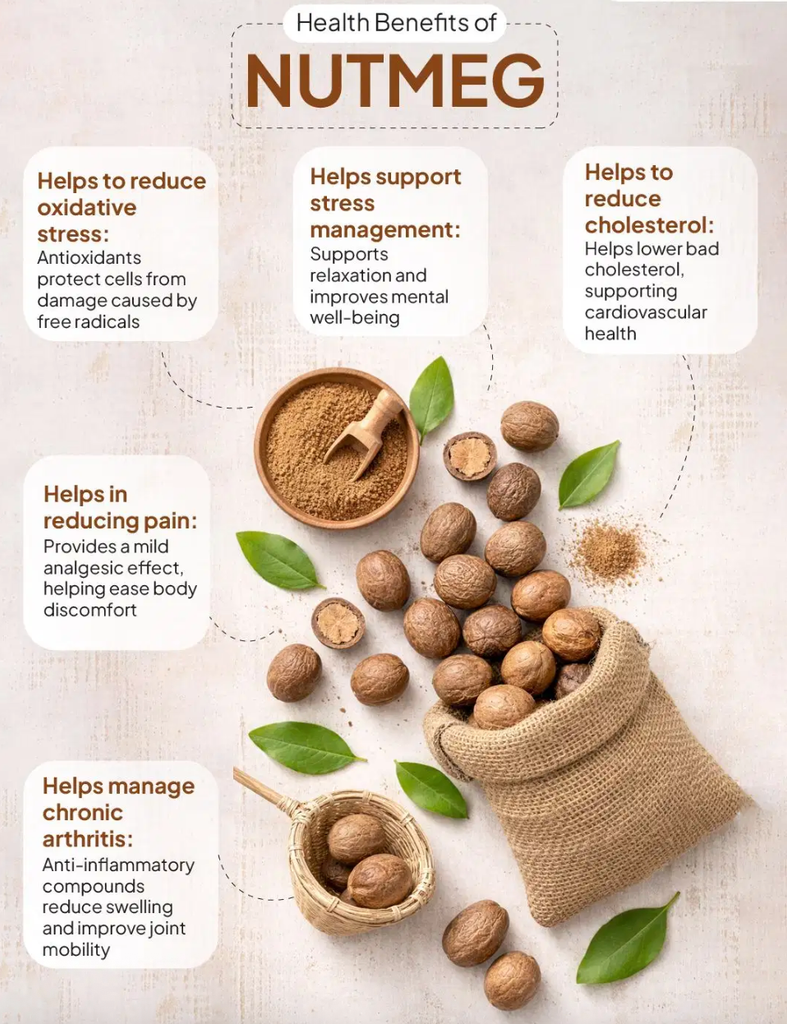
Nutmeg Benefits: What Does Research Say?
The interest in nutmeg benefits comes largely from its phytochemical composition. Researchers have investigated compounds in nutmeg for antioxidant, antimicrobial, anti-inflammatory and other biological activities.
However, an important distinction needs to be made between laboratory research and proven human health benefits. A compound showing an effect in a laboratory experiment does not automatically mean that consuming nutmeg will produce the same effect in the human body.
Current research therefore suggests that nutmeg contains potentially useful bioactive compounds, but more human studies are needed to establish specific health benefits.
1. Nutmeg Contains Antioxidant Compounds
One of the most researched health properties of nutmeg is its antioxidant activity.
Nutmeg contains several plant compounds that have demonstrated antioxidant activity in laboratory studies. Antioxidants are substances that can help counter oxidative stress by interacting with reactive molecules.
This is one reason spices and other plant-based foods are often studied as potential sources of beneficial phytochemicals. However, consuming more nutmeg does not necessarily mean getting more antioxidant benefits. A varied diet containing fruits, vegetables, legumes, whole grains, nuts, seeds and other spices provides a much broader range of nutrients and plant compounds.
2. Nutmeg Has Traditionally Been Used for Digestion
Digestive wellness is another area associated with traditional nutmeg benefits. Nutmeg has been used in traditional preparations as a digestive spice and has historically been included in formulations intended to support digestion.
Some experimental studies have explored the effects of nutmeg compounds on gastrointestinal processes. However, human evidence remains limited.
Adding a small amount of nutmeg to food can be a simple way to enjoy its flavour, but it should not replace medical care if you experience persistent digestive symptoms such as abdominal pain, vomiting, unexplained weight loss or significant changes in bowel habits.
3. Nutmeg Benefits for Skin Health
There is growing interest in nutmeg benefits for skin because some of its naturally occurring compounds have antioxidant and antimicrobial properties.
Oxidative stress and inflammation are involved in several aspects of skin health, which is why botanical ingredients with antioxidant properties are commonly explored in skincare. Nutmeg has also been used traditionally in certain topical preparations.
However, the evidence surrounding nutmeg benefits for skin is still developing. Laboratory findings cannot be treated as proof that nutmeg will prevent acne, pigmentation, scars or signs of ageing in humans.
If nutmeg is used in a skincare formulation, the concentration and complete formulation matter. Applying concentrated nutmeg, powders or essential oils directly to the skin can potentially cause irritation, especially for people with sensitive skin.
4. Nutmeg May Have Antimicrobial Properties
Another potential area of interest among the health properties of nutmeg is antimicrobial activity.
Certain compounds found in nutmeg have demonstrated activity against microorganisms in laboratory studies. This has encouraged researchers to investigate whether nutmeg-derived compounds could have applications in food preservation, cosmetics and other areas.
However, laboratory antimicrobial activity does not mean that consuming nutmeg can treat an infection. More research is required to understand whether these properties have meaningful applications in human health.
5. Nutmeg and Traditional Relaxation Practices
Nutmeg has traditionally been associated with relaxation and sleep in some wellness practices. This has led to interest in whether it can support better sleep.
Although traditional use is worth understanding, there is currently limited high-quality human evidence to establish nutmeg as a reliable sleep aid.
If sleep problems are persistent, improving sleep timing, managing stress, reducing late-night screen use and addressing caffeine intake are more practical starting points than consuming large amounts of nutmeg.
Nutmeg Benefits for Skin: Can You Use It Directly?
The popularity of natural skincare has increased interest in nutmeg benefits for skin, particularly because of its antioxidant and antimicrobial properties.
However, natural does not automatically mean suitable for direct application. Nutmeg is a concentrated spice, and its essential oils and other compounds may irritate the skin when used incorrectly.
If you want to explore nutmeg benefits for skin, a properly formulated skincare product is generally a more controlled option than applying kitchen-grade nutmeg directly to the face.
People with sensitive or reactive skin should be especially cautious and consider patch testing an appropriately formulated product before wider use.
Nutmeg in Ayurveda
Nutmeg has a long history in Ayurveda, where it is known as Jatiphala. Traditional Ayurvedic practices have used it in different preparations and combinations with other ingredients.
This history contributes to the modern interest in nutmeg as an Ayurvedic ingredient. However, traditional use and modern clinical evidence should be kept separate.
Traditional knowledge can help identify ingredients worthy of scientific investigation, but it does not automatically establish that an ingredient can prevent, treat or cure a particular medical condition.
How Can You Use Nutmeg?
The most straightforward way to include nutmeg in your lifestyle is as a culinary spice.
You can add small quantities of ground nutmeg to:
- Curries and savoury dishes
- Soups and sauces
- Oatmeal
- Desserts
- Baked foods
- Milk-based beverages
- Smoothies
- Spice blends
Because nutmeg has a strong flavour, a small amount is usually enough.
Nutmeg is also used as an ingredient in some herbal and Ayurvedic formulations. If you choose such a product, check the complete ingredient list, recommended usage and manufacturer information rather than focusing only on the presence of nutmeg.
Is Nutmeg Safe?
Nutmeg is generally used in small culinary quantities. The safety concern arises when people consume unusually large amounts in an attempt to obtain stronger nutmeg benefits.
Nutmeg contains compounds such as myristicin. In excessive quantities, these compounds can produce toxic effects and may cause symptoms such as nausea, dizziness, confusion, rapid heartbeat and other adverse reactions.
This is why nutmeg should be treated as a spice rather than a substance where taking more is assumed to provide greater wellness benefits.
If you are pregnant, taking medication, managing a health condition or considering concentrated nutmeg supplements, speak with a qualified healthcare professional before using them regularly.
Nutmeg in Modern Herbal Wellness
Nutmeg continues to appear in modern herbal and Ayurvedic formulations because of its traditional history and naturally occurring botanical compounds.
For example, 8848 Herbs includes nutmeg alongside botanical ingredients such as saffron, clove and cinnamon in its Organic Delay Cream, a topical product designed specifically for men’s sexual wellness.
In this formulation, nutmeg is one ingredient within a broader botanical blend. It should not be viewed in isolation or treated as a standalone solution for sexual health concerns.
This is an important consideration when choosing herbal wellness solutions. Instead of focusing on one ingredient, look at the complete formulation, intended use, directions and quality information provided by the brand.
What Does Research Actually Tell Us About Nutmeg?
Research into nutmeg has identified several potentially interesting biological properties. Studies have explored its antioxidant, antimicrobial and anti-inflammatory activity, as well as other effects associated with individual compounds found in the spice.
However, much of this evidence comes from laboratory and animal research. Human clinical evidence is considerably more limited.
This means that the most accurate way to discuss nutmeg benefits is to say that nutmeg contains bioactive compounds with promising properties that are being investigated not that nutmeg has been clinically proven to treat a specific health condition.
This distinction is especially important when researching natural or Ayurvedic ingredients online. Strong claims based only on laboratory research can easily make an ingredient appear more established than it actually is.
The Bottom Line
Nutmeg is more than a flavouring spice. Its traditional use, nutritional composition and naturally occurring plant compounds make it an interesting ingredient for nutrition, Ayurveda and modern herbal wellness.
The potential nutmeg benefits include antioxidant and antimicrobial properties that researchers continue to investigate. There is also growing interest in nutmeg benefits for skin, but current evidence is not strong enough to make specific treatment claims.
The best approach is to enjoy nutmeg in sensible culinary quantities and evaluate herbal products based on their complete formulation, quality and intended use. As research develops, nutmeg remains an interesting example of how traditional ingredients can be studied through a modern scientific lens.
FAQ
What are the main nutmeg benefits?
The main potential nutmeg benefits being researched relate to its antioxidant, antimicrobial and other biological properties. Nutmeg has also been traditionally used for digestive and general wellness purposes, although strong human evidence for specific therapeutic benefits remains limited.
What are the health properties of nutmeg?
The health properties of nutmeg are linked to its naturally occurring plant compounds, including phenolic compounds and aromatic constituents. Research has explored antioxidant, antimicrobial and anti-inflammatory activity, but much of the evidence remains preclinical.
What are the benefits of nutmeg for skin?
Interest in nutmeg benefits for skin comes from its antioxidant and antimicrobial properties observed in laboratory research. However, there is not enough human evidence to establish nutmeg as a treatment for acne, pigmentation, scars or other specific skin conditions.
Can I use nutmeg directly on my skin?
It is better to avoid applying concentrated nutmeg powder or essential oil directly to the skin because it may cause irritation. If you want to explore nutmeg benefits for skin, choose a properly formulated product and follow its usage instructions.
Can nutmeg help with digestion?
Nutmeg has traditionally been used as a digestive spice, and some experimental research has explored its gastrointestinal properties. However, there is limited human evidence to support using nutmeg as a treatment for digestive disorders.
Is nutmeg an Ayurvedic ingredient?
Yes. Nutmeg, known as Jatiphala, has a long history of use in Ayurveda. It appears in various traditional formulations, although traditional use should not be confused with clinical proof of a specific health benefit.
Can you consume nutmeg every day?
Small amounts used as a culinary spice are very different from consuming concentrated quantities. Avoid consuming large amounts of nutmeg because excessive intake can cause toxic effects.
Does nutmeg help you sleep?
Nutmeg has traditionally been associated with relaxation and sleep, but there is insufficient high-quality human evidence to establish it as an effective sleep treatment. Persistent sleep problems should be discussed with a healthcare professional.