

Table of Contents
- What Makes Ayurvedic Herbs Different?
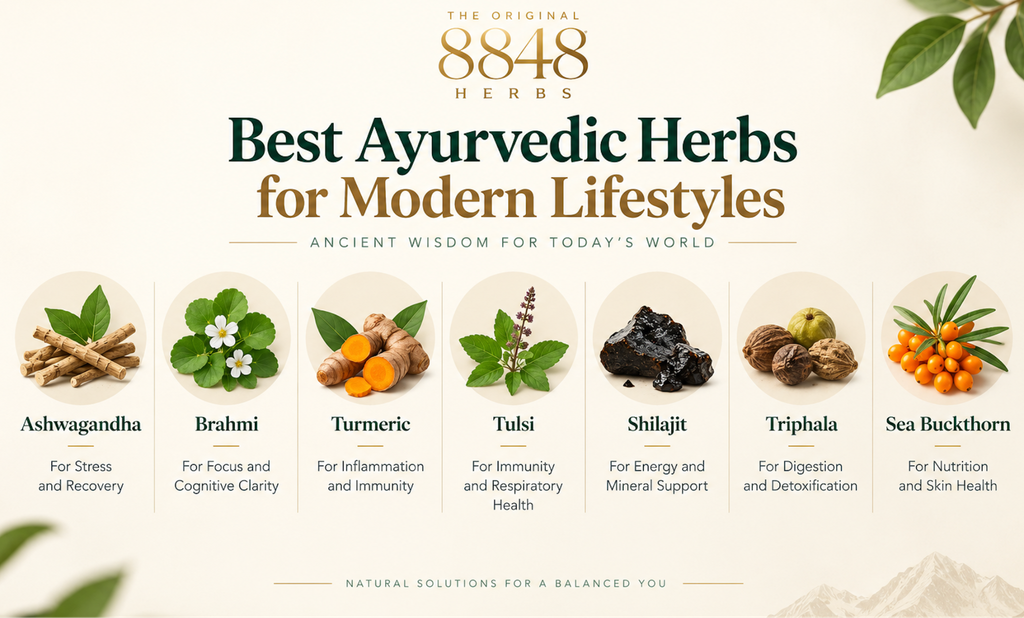
- The Best Ayurvedic Herbs for Modern Lifestyles
- Ashwagandha for Stress and Recovery
- Brahmi for Focus and Cognitive Clarity
- Turmeric for Inflammation and Immunity
- Tulsi for Immunity and Respiratory Health
- Shilajit for Energy and Mineral Support
- Triphala for Digestion and Detoxification
- Sea Buckthorn for Nutrition and Skin Health
- Ayurvedic Herbs for Immunity: What Actually Matters
- Building an Ayurvedic Herb Routine That Actually Sticks
- 8848 Herbs: Where Traditional Knowledge Meets Modern Standards
- The Bottom Line
- FAQs
Quick Summary
Ayurvedic herbs can support common modern wellness needs such as stress management, energy, cognitive function, digestion, immunity and skin health. From Ashwagandha and Brahmi to Shilajit and Sea Buckthorn, the right herb depends on your specific goal, while choosing quality products with transparent sourcing and appropriate certifications is equally important.
Ayurvedic herbs have been part of human health for over 5,000 years. And right now, more people are coming back to them than at any point in recent memory.
That’s not nostalgia. It’s a response to something real – chronic stress, poor sleep, depleted energy, an immune system that feels like it’s always one bad week away from failing. Modern life creates these problems reliably. Conventional approaches don’t always have satisfying answers for them.
But Ayurveda does. The herbs at the centre of that system are increasingly well-studied, more widely available than they’ve ever been, and genuinely useful once you understand what they actually do.
No Sanskrit overload or mysticism! Just what the best Ayurvedic herbs are, what they do, and how to fit them into a real daily routine.
What Makes Ayurvedic Herbs Different?
The short answer is that they’re designed to work on the whole system, not just a single symptom.
Ayurvedic practice classifies herbs according to the effect on three biological forces: Vata, Pitta, and Kapha, that govern movement and nervous system function, metabolism, and immunity, respectively. Herbs are chosen to restore balance across these systems rather than suppress whatever’s most obviously wrong.
That’s a different logic from most modern medicine, and it’s why Ayurvedic herbs tend to work gradually and systemically. They’re not designed to hit a biomarker and to shift a state.
Modern pharmacology has started catching up. The category of adaptogens, i.e. the herbs that help the body regulate its stress response, maps almost exactly onto what Ayurveda classified as Rasayana herbs centuries ago. It’s a different vocabulary but overlapping observations.
The Best Ayurvedic Herbs for Modern Lifestyles
Ashwagandha for Stress and Recovery
If you’ve spent any time in wellness circles recently, you’ve heard of ashwagandha. The attention is warranted.
Its active compounds, withanolides, modulate the system that governs cortisol production. Chronic stress keeps cortisol elevated, resulting in wrecked sleep, suppressed testosterone, driven inflammation, and drained energy. Ashwagandha interrupts that cycle, not by sedating you, but by helping the body actually regulate itself again.
The research is solid. Multiple randomised controlled trials have shown meaningful reduction in cortisol levels, better sleep quality, lower anxiety scores, and improved physical performance in active adults. Effects build over 8 to 12 weeks of consistent use.
For anyone running on stress fumes, this is probably the single most relevant herb on this list.
Brahmi for Focus and Cognitive Clarity
Brahmi has been used in Ayurvedic practice for over a thousand years for cognitive support. Neuroscience has taken a genuine interest in it, and the results hold up.
The active compounds, like bacosides, support synaptic communication and neuronal protection. Multiple trials have shown real improvements in memory, learning speed, and information processing. Not a stimulant effect, not caffeine-adjacent jitteriness. Just a quieter, more reliable sharpness that builds over weeks.
For mental fatigue, brain fog, or the cognitive sluggishness that follows sustained stress, Brahmi is one of the better-supported options in this category. It’s not dramatic but works wonders.
Turmeric for Inflammation and Immunity
Turmeric barely needs an introduction. But its reputation as a kitchen spice undersells what it actually does.
Curcumin, the active compound, inhibits NF-kB, a molecular switch that turns on inflammatory gene expression. Chronic low-grade inflammation is behind a staggering range of modern health problems: metabolic dysfunction, accelerated ageing, immune dysregulation. Turmeric’s relevance isn’t limited to joint pain; it’s system-wide.
One practical note: curcumin absorbs poorly on its own. Black pepper (piperine) dramatically increases absorption, up to 2,000% in some studies. Traditional Ayurvedic formulations combined turmeric with other spices for exactly this reason. The synergy wasn’t accidental.
Tulsi for Immunity and Respiratory Health
Holy Basil is one of the most widely used herbs in Ayurveda and one of the most underrated in modern wellness. It’s an adaptogen, so it shares some of ashwagandha’s stress-modulating properties. But its specific strengths are antimicrobial activity, immune support, and respiratory health.
The essential oil compounds in Tulsi have documented antimicrobial and expectorant properties, which is why it’s been used traditionally for coughs, colds, and bronchial conditions. It’s also one of the gentlest herbs on this list. A daily cup of Tulsi tea is a legitimate wellness habit, not a supplement routine.
Shilajit for Energy and Mineral Support
Shilajit isn’t technically a herb. It’s a mineral resin that forms over centuries in high-altitude Himalayan rock, which is a compressed organic matter transformed by geological pressure into something genuinely unusual.
The primary active compound, fulvic acid, supports mitochondrial function. Better mitochondria means more efficient energy production at the cellular level. Not stimulant energy that crashes but sustained, underlying energy from cells that are actually working the way they’re supposed to.
For anyone dealing with deep physical fatigue, poor recovery, or the mineral depletion that comes from years of processed food, Shilajit addresses something most herbal supplements don’t touch at all.
Triphala for Digestion and Detoxification
Triphala is a classical Ayurvedic formulation that combines three fruits: Amalaki, Bibhitaki, and Haritaki. It’s one of the most used preparations in the entire system, and modern research on gut health explains why.
Triphala has documented prebiotic properties, antioxidant activity, and a genuine role in supporting digestive regularity. Ayurveda has always placed digestion at the centre of overall health. Modern microbiome research is validating that emphasis in ways no traditional practitioner would find surprising.
If your digestion is sluggish, or detoxification feels stuck, or you just feel metabolically off, Triphala is a well-evidenced place to start.
Sea Buckthorn for Nutrition and Skin Health
Sea buckthorn is a high-altitude Himalayan berry with a nutritional profile unlike anything else in the plant world. It’s one of the plant sources that contain all four omega fatty acids: 3, 6, 7, and 9, alongside exceptionally high vitamin C, carotenoids, and vitamin E.
In an Ayurvedic context, sea buckthorn sits in a specific niche: dense, broad-spectrum nutritional support that underpins the more targeted work of adaptogens like ashwagandha and shilajit. Where those herbs address hormonal and cellular systems, sea buckthorn provides the micronutrient base those systems actually run on.
The skin health angle, driven by omega-7 content and carotenoid density, makes it particularly relevant for the oxidative stress and inflammation that modern lifestyles accelerate in visible ways.
Ayurvedic Herbs for Immunity: What Actually Matters
“Boosting immunity” is a phrase worth interrogating. The immune system doesn’t benefit from being universally ramped up; that’s actually what autoimmune conditions are. What most people mean is a more resilient, better-regulated immune response.
The herbs most relevant here:
Tulsi: antimicrobial, adaptogenic, supports respiratory immunity directly.
Turmeric: anti-inflammatory, supports immune regulation rather than indiscriminate activation.
Amalaki: one of the richest natural sources of vitamin C, central to Triphala, and a cornerstone Rasayana herb for immune resilience.
Shilajit: supports the mineral availability immune cell function depends on, including zinc, which is directly involved in immune signalling.
Sea buckthorn: vitamin C density and carotenoid content provide antioxidant support that underpins immune function at a nutritional level.
None of these can replace adequate sleep, managed stress, and reasonable nutrition. They work best as support on top of those foundations, but not instead of them.
Building an Ayurvedic Herb Routine That Actually Sticks
Start with one herb. The most common mistake is taking everything at once and having no idea what’s working. Pick the herb that’s most relevant to your primary concern and give it 6 to 8 weeks. Add from there if needed.
Consistency beats quantity every time. A small daily dose taken for two months will outperform a large sporadic dose taken whenever you remember. These aren’t acute interventions because they work on underlying systems over time.
Form matters as well. Juices and liquid extracts work well for water-soluble compounds. Fat-soluble nutrients such as carotenoids, omega fatty acids, and fat-soluble vitamins absorb better alongside food containing some dietary fat. Match the format to what you’re trying to get out of it.
Know that quality determines everything. The act of sourcing, processing, and certification decides whether you’re getting the active compounds the herb is supposed to deliver. Therefore, AYUSH certification, ISO quality standards, and transparent sourcing are the minimum markers worth looking for.
8848 Herbs: Where Traditional Knowledge Meets Modern Standards
8848 Herbs sources from high-altitude Himalayan environments, the conditions that produce genuine compound density in plants, not agricultural convenience. The product range covers sea buckthorn in multiple forms, shilajit-infused formulations, and Ayurvedic botanicals processed and preserved to keep them active.
- AYUSH certified.
- ISO 9001:2015 and ISO 14001:2015 compliant.
- Small-batch production.
- Transparent sourcing.
Those aren’t decorative credentials but specific markers that separate a brand with substance from one that’s borrowed Ayurveda’s language without earning it.
The Bottom Line
Ayurvedic herbs aren’t a rejection of modern medicine. They’re a parallel tradition of knowledge about how plants support human health, i.e. one that modern research is increasingly validating rather than dismissing.
The best ones for modern lifestyles address exactly what modern lifestyles damage most reliably: stress regulation, immune resilience, cognitive function, digestive health, cellular energy. Those aren’t niche concerns but primarily the foundation everything else runs on.
Right herb. Right source. Enough time. That’s really all there is to it.
FAQs
Are Ayurvedic herbs safe for long-term daily use?
Most traditional herbs like ashwagandha, tulsi, turmeric, and triphala have centuries of daily use and modern safety studies supporting their tolerability at standard doses. Individual contraindications exist (pregnancy, thyroid conditions, specific medication interactions). Long-term use at high doses without any professional guidance isn’t ideal for any supplement category.
Can a complete beginner use adaptogenic herbs without guidance?
Yes, with two caveats. Start with single-herb products you can actually evaluate rather than complex proprietary blends. And if you have existing health conditions or take prescription medication, check with your doctor first because several Ayurvedic herbs have documented interactions with common medications.
How do I know if a product is genuine?
1. AYUSH certification for Indian Ayurvedic products, 2. Third-party lab testing, and 3. Specific sourcing information are not just “natural” or “Himalayan” as a vague descriptor but a proper ISO quality certificate. If a brand can’t answer basic questions about where their herbs come from and how they’re processed, that silence tells you something.
Which herb should I start with?
For stress and poor sleep, opt for ashwagandha; for general immunity and respiratory health, go for tulsi; for digestive issues, opt for triphala; for mental fatigue and focus, go for brahmi; for deep physical fatigue and mineral depletion, shilajit is a good option, and for nutritional density and skin health, you can trust sea buckthorn. Match the herb to the problem and not to whatever’s trending.