

Table of Contents
- What Makes Himalayan Herbs Different?
- A Brief History of Himalayan Herbs in India
- Key Himalayan Herbs and Their Benefits
- Ashwagandha (Withania somnifera)
- Brahmi (Bacopa monnieri)
- Shilajit
- Saffron (Crocus sativus)
- Sea Buckthorn (Hippophae rhamnoides)
- Tulsi (Ocimum tenuiflorum)
- Kutki (Picrorhiza kurroa)
- Benefits of Himalayan Herbs: The Common Threads
- What to Look for in a Himalayan Herb Brand in India
- How to Use Himalayan Herbs Effectively
- The Bottom Line
Quick Summary
Himalayan herbs are valued for their diverse nutrients and bioactive compounds, with potential benefits for stress management, skin health, antioxidant support, cognitive function, digestion, and everyday vitality. This guide helps readers understand which herbs may support specific wellness needs, what to look for when choosing herbal products, and why authentic Himalayan sourcing, quality processing, transparency, and responsible formulations matter when choosing products from brands such as 8848 Herbs.
Himalayan herbs have been quietly doing the heavy lifting in traditional medicine for thousands of years. Long before wellness became an industry, communities living across the Himalayas, from Ladakh to Nepal to the high valleys of Uttarakhand, relied on the plants growing around them for everything from wound healing to respiratory support to daily vitality.
Now the rest of the world is catching up. And it turns out the knowledge was right all along.
This isn’t a trend piece. It’s a practical guide to what Himalayan herbs actually are, which ones matter, what the research says, and how to think about using them well.
What Makes Himalayan Herbs Different?
Before getting into specific herbs, it’s worth understanding why herbs from this region are considered particularly potent.
The Himalayan range is one of the most biodiverse regions on the planet. It spans multiple climate zones, from subtropical foothills to cold alpine plateaus above 4,000 metres. Plants growing at extreme altitudes are under constant environmental stress — intense UV radiation, harsh winters, thin air, rocky mineral-rich soil with very little organic matter.
Plants respond to stress by producing more protective compounds. Antioxidants, alkaloids, flavonoids, essential oils. These are the same compounds that make a herb medicinally active. High-altitude stress, paradoxically, makes the plant denser with the things that make it useful.
This is why Himalayan herbs in India are increasingly sought after not just in traditional Ayurvedic practice but in modern nutraceutical and cosmetic formulations. The raw material is genuinely different from what grows at lower altitudes or in more controlled agricultural conditions.
A Brief History of Himalayan Herbs in India
Himalayan herbs have been central to three major traditional medicine systems practised across the region: Ayurveda, Siddha, and Sowa-Rigpa (Tibetan medicine). Each system developed its own understanding of the same plants, often arriving at overlapping conclusions through centuries of observation and use.
Ayurveda, the oldest of these systems, classifies herbs according to their effect on the body’s doshas, viz. Vata, Pitta, and Kapha — and uses them in combinations rather than isolation. Many of the herbs used in Ayurvedic formulations for thousands of years are sourced specifically from Himalayan regions because the altitude and climate produce more potent raw material.
The British colonial period actually documented a significant portion of this knowledge for the first time in botanical records, often crediting local practitioners whose names were never recorded. Post-independence, India established research institutions, namely the Central Council for Research in Ayurvedic Sciences (CCRAS), specifically to study and validate this traditional knowledge using modern methods.
What’s emerged from decades of research is a clearer picture of which traditional uses have scientific backing, which are promising but need more study, and which were always more ritual than medicinal. That distinction matters, and you’ll see it drawn clearly throughout this article.
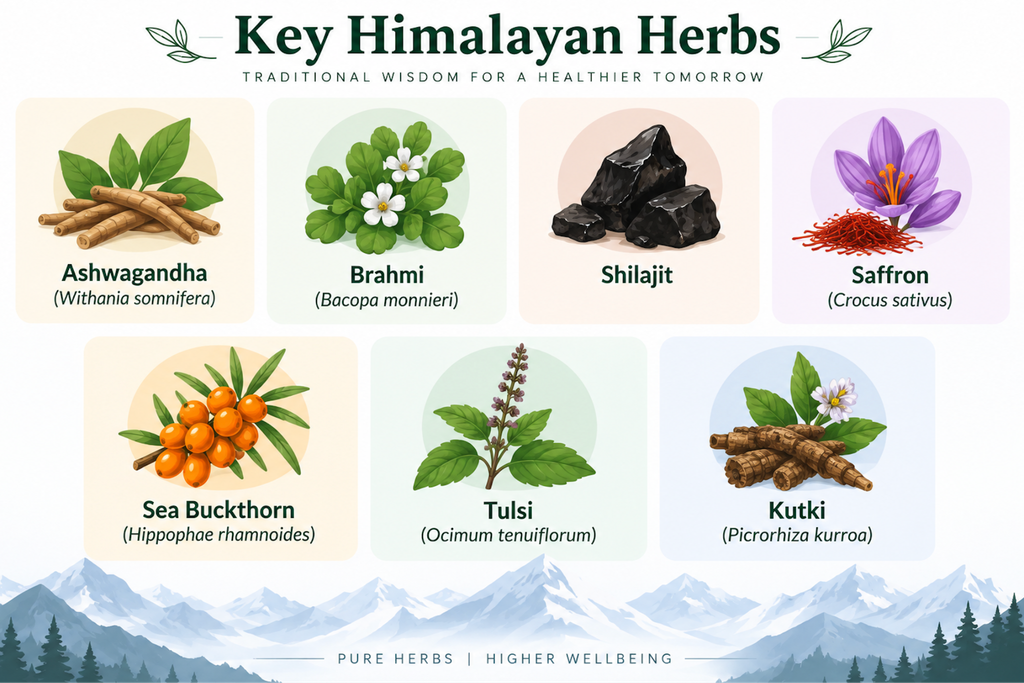
Key Himalayan Herbs and Their Benefits
Ashwagandha (Withania somnifera)
Ashwagandha is probably the most globally recognised Himalayan herb in India right now. It’s an adaptogen, meaning it’s studied for its ability to help the body manage physiological stress responses.
The active compounds are withanolides, a class of steroidal lactones that have been studied extensively in recent years.
What the research supports:
- Reduction in cortisol levels (the primary stress hormone) with consistent use over several weeks
- Improvements in self-reported sleep quality in multiple clinical trials
- Some evidence for supporting muscle strength and recovery in physically active adults
- Preliminary evidence supporting male reproductive health markers
What’s still being studied: long-term safety data, optimal dosing, and effectiveness across different population groups.
It’s not a sedative, and it’s not a stimulant. It’s a regulating compound, which is why it takes weeks of consistent use to show results rather than hours.
Brahmi (Bacopa monnieri)
Brahmi has been used in Ayurvedic practice as a part of cognitive support for well over a thousand years. Modern neuroscience research has taken a genuine interest in it, and the results are interesting.
The active compounds are bacosides, which are studied for their effect on neurotransmitter activity and neuronal communication.
What the research supports:
- Improved performance on memory and cognitive function tests in both older adults and younger populations in multiple randomised trials
- Reduction in anxiety measures in some clinical studies
- Potential neuroprotective properties, particularly relevant for age-related cognitive decline
Brahmi is one of the better-researched herbs in this category. The evidence base is more developed than most. That said, effects are gradual and cumulative, not immediate.
Shilajit
Shilajit isn’t technically a herb. It’s a resinous mineral compound that seeps from Himalayan rocks, formed over centuries from the decomposition of plant matter under geological pressure. It ends up here because it’s one of the most important substances in Himalayan traditional medicine and increasingly in modern supplementation.
The primary active compound is fulvic acid, along with over 80 trace minerals.
What the research supports:
- Support for mitochondrial function, which affects cellular energy production
- Some evidence for testosterone support in men with low baseline levels
- Potential role in supporting cognitive health through antioxidant mechanisms
- Traditional use for altitude sickness adaptation, which has some biological plausibility given its mineral and fulvic acid content
Quality varies enormously. Authentic Shilajit sourced from high-altitude Himalayan rock faces is very different from low-grade resin processed at scale. Purification matters significantly for both safety and efficacy.
Saffron (Crocus sativus)
Saffron grown in the Kashmir Valley is among the most prized in the world; it earns that reputation not just for culinary use but for its medicinal profile.
The active compounds are crocin, crocetin, and safranal.
What the research supports:
- One of the more robustly studied natural compounds for mood support, with multiple trials showing effects comparable to low-dose antidepressants for mild to moderate symptoms
- Antioxidant activity, particularly relevant for eye health (carotenoid density supports macular protection)
- Traditional use in Ayurveda for vitality and stamina, supported by some preliminary research on its effect on circulation and energy markers
Saffron is expensive because harvesting it is genuinely labour-intensive, as each flower produces three stigmas, all of which are hand-picked. Products claiming to use meaningful quantities of saffron at very low price points should be questioned.
Sea Buckthorn (Hippophae rhamnoides)
Native to the cold river valleys and high-altitude regions of Ladakh and the greater Himalayan belt, sea buckthorn is a nutrient-dense berry that’s gaining serious attention in both nutrition and skincare research.
What sets it apart is the combination of omega-3, omega-6, omega-7, and omega-9 fatty acids in a single plant source. Omega-7 (palmitoleic acid) in particular is rare in plant foods and is studied for its role in supporting skin membrane integrity and mucosal health.
The vitamin C content is substantially higher than that of most commonly consumed fruits, while the carotenoid profile gives it its characteristic orange colour and contributes to its antioxidant density.
What the research supports:
- Skin health support through both topical and dietary pathways
- Immune support through the vitamin C and antioxidant profile
- Digestive mucosal support, particularly studied in the context of gastric health
- General vitality and nutritional density as a daily supplement
Tulsi (Ocimum tenuiflorum)
Known as Holy Basil, Tulsi is one of the most widely used plants in Ayurvedic practice. It grows across India, but the varieties cultivated in the Himalayan foothills are considered particularly active.
What the research supports:
- Adaptogenic properties similar to ashwagandha, with evidence for stress hormone modulation
- Antimicrobial activity against a range of pathogens in laboratory studies
- Blood sugar regulation support in some clinical trials
- Respiratory support, which aligns with its traditional use for coughs, colds, and bronchial conditions
Tulsi is also one of the most accessible herbs in this list for daily use as a tea, in cooking, or as a supplement.
Kutki (Picrorhiza kurroa)
Kutki is less globally known than the others on this list but is highly regarded in both Ayurvedic and Tibetan medicine, specifically for liver and digestive support.
It grows at high altitudes in the Himalayas, typically between 3,000 and 5,000 metres. The active compounds are picrosides, which have been studied for hepatoprotective (liver-protecting) properties.
What the research supports:
- Liver enzyme normalisation in studies involving patients with liver stress
- Anti-inflammatory activity
- Immune modulation
Kutki is increasingly relevant in modern formulations because liver health is a growing focus in preventive wellness, and the research behind this herb is more developed than many consumers realise.
Benefits of Himalayan Herbs: The Common Threads
Looking across these herbs, a few patterns emerge in the benefits of Himalayan herbs that are worth understanding.
Adaptogenic activity: Many Himalayan herbs are classified as adaptogenic compounds that help the body regulate its response to physical, chemical, or biological stress. This isn’t a vague claim. It describes a specific mechanism that’s been studied in modern pharmacology.
Antioxidant density: High-altitude stress on plants produces high concentrations of protective compounds. These translate into strong antioxidant activity after consumption, which is relevant for inflammation management, skin health, and cellular ageing.
Gradual, cumulative effect: This is important to understand. Himalayan herbs generally don’t produce immediate, dramatic effects. They work over weeks and months of consistent use. People expecting results in three days are setting themselves up for disappointment, and brands promising overnight transformation should be questioned.
Synergy over isolation: In traditional Ayurvedic formulas, herbs are used in combination, and not in isolation. Modern research increasingly finds that this approach has a biological basis; compounds in one herb can enhance the bioavailability or activity of compounds in another.
What to Look for in a Himalayan Herb Brand in India
This is where sourcing, processing, and transparency separate genuinely useful products from marketing exercises.
A few things to check:
Sourcing specificity. A brand worth trusting tells you exactly where its herbs come from. “Himalayan sourced” without a region, altitude, or collection method is a vague claim. Ecosystems like Ladakh, Kashmir, Uttarakhand, and Sikkim produce herbs with different potency profiles. Specificity is a signal of seriousness.
Processing method. Heat and chemical processing degrade active compounds. Cold processing, minimal intervention methods, and low-temperature drying preserve what makes the herb effective. A brand that can explain its processing method tends to understand its product.
Certifications. Look for AYUSH certification for Ayurvedic products, which confirms the formulation meets regulatory standards. ISO 9001:2015 for quality management and ISO 14001:2015 for sustainable, eco-friendly manufacturing are also meaningful markers and not just labels.
Batch transparency. Small-batch production isn’t just a marketing line. It means tighter quality control, more consistent potency, and less risk of the degradation that happens when a product sits in large-batch inventory for months.
What the brand doesn’t claim. Honest brands are as notable for what they don’t say as for what they do. If a brand is making disease cure claims or promising results in 24 hours, walk away.
8848 Herbs is built around these principles: Himalayan sourcing, authentic high-grade botanicals, small-batch production, and formulations that respect what the herbs actually do rather than overpromising what they can’t.
How to Use Himalayan Herbs Effectively
A few practical points that apply across the category:
Consistency matters more than quantity. A small daily dose consistently for eight weeks will generally outperform a large dose taken sporadically. These are nutritional and adaptogenic compounds, not pharmaceuticals.
Form affects bioavailability. Juices and liquid extracts tend to deliver water-soluble nutrients quickly. Oils and fat-soluble extracts require a fat-containing meal to be absorbed properly. Powders vary depending on how they’re processed. Match the form to the nutrient type you’re targeting.
Stack thoughtfully. If you’re taking multiple herbs simultaneously, research whether they interact. Most common combinations are fine, but some herbs affect the same pathways and doubling up doesn’t double the benefit.
Medication interactions. Ashwagandha, saffron, and sea buckthorn all have documented interactions with specific medications. If you’re on prescription medication, particularly for thyroid, blood pressure, blood thinning, or mood, check with your doctor before adding these to your routine.
The Bottom Line
Himalayan herbs aren’t a discovery. They’re an old body of knowledge that modern research is finally catching up to. The benefits of Himalayan herbs span immunity, cognitive function, skin health, stress management, vitality, and more, and the science behind them is stronger than most people realise.
But they’re not magic, and they’re not instant. They work when you use the right herb for the right purpose, from a source you can trust, consistently.
That’s the whole framework. Everything else is details.
FAQs
Are Himalayan herbs safe to use daily?
Most are, at standard supplemental doses, for healthy adults. The herbs with the longest safety records, Tulsi, Ashwagandha, and Brahmi, have been used daily in traditional practice for generations. Always check for specific contraindications with pregnancy, breastfeeding, or existing health conditions.
Which Himalayan herb is best for the skin?
Sea buckthorn is the most studied for skin health, both topically and through dietary intake. Saffron also has a long traditional association with skin nourishment. For general antioxidant support that benefits the skin over time, most herbs on this list contribute indirectly.
How long before I see results?
For most Himalayan herbs used for wellness support, four to eight weeks of consistent daily use is a realistic minimum before noticeable changes. Cognitive benefits from Brahmi have been documented in trials spanning 12 weeks. Managing expectations here is important.
Which herbs support energy and vitality specifically?
Shilajit, Ashwagandha, and Saffron are the most studied for vitality and energy-related applications. Sea buckthorn’s nutrient density tends to contribute to general energy metabolism through vitamins and fatty acids. None of these is a stimulant; they support the underlying systems that produce energy rather than forcing a short-term spike.
Are Himalayan herbs better than synthetic supplements?
Different, rather than straightforwardly better. Synthetic supplements can deliver precise, isolated doses of a single compound. Herbal formulations deliver complex matrices of compounds that often work synergistically. For general wellness support, the herbal approach has a longer track record and often a gentler physiological profile. To address a specific deficiency, a targeted supplement may be more efficient.
What’s the best way to start if I’ve never used these herbs before?
Start with one herb rather than a stack of five. Ashwagandha or Tulsi are good entry points: well-tolerated, well-researched, and widely available from reputable Indian brands. Give it six to eight weeks of consistent use before evaluating whether it’s working.