

Table of Contents
- What Is Shilajit?
- What Is Ashwagandha?
- The Core Difference Between Shilajit and Ashwagandha
- Shilajit vs Ashwagandha: Quick-Glance Difference
- Shilajit: What It Does Best
- Ashwagandha: What It Does Best
- Which Is Better: Shilajit or Ashwagandha?
- 8848 Herbs: Shilajit and Sea Buckthorn Together
- How to Take Each One
- FAQs
- The Bottom Line
Quick Summary
Shilajit and Ashwagandha are both Ayurvedic wellness ingredients, but they are not the same and are not interchangeable. Shilajit is a mineral-rich substance traditionally associated with energy, stamina, mineral availability and male vitality, while Ashwagandha (Withania somnifera) is an adaptogenic herb more commonly studied for stress, cortisol management, sleep, anxiety and recovery. In simple terms, Shilajit is primarily positioned around cellular energy and vitality, while Ashwagandha is primarily positioned around stress and nervous-system support. 8848 Herbs takes a different approach by combining Himalayan Shilajit with wild-harvested Himalayan sea buckthorn in its Shilajit-infused sea buckthorn juice, bringing together Shilajit’s traditional vitality role with the nutritional profile of sea buckthorn, including vitamin C, carotenoids and omega-7.
Shilajit vs ashwagandha is one of the most common questions in Ayurvedic wellness right now because:
- Both are considered foundational ingredients in the Ayurvedic system,
- Both are associated with energy, vitality, and stress support, and
- Both are showing up in supplements, juices, and wellness products across India and globally.
But they’re not interchangeable. They work through different mechanisms, target different systems, and suit different people depending on what’s actually going on.
This guide breaks down the real difference between shilajit and ashwagandha: what each one does, where it works best, who should use which, and whether combining them makes sense.
What Is Shilajit?
Shilajit is a mineral-rich resin that forms over centuries in high-altitude mountain rocks, primarily in the Himalayas. It’s the compressed, transformed residue of organic plant matter slowly broken down under geological pressure over hundreds to thousands of years. This takes place until it becomes a dense, tar-like substance that seeps from rock faces during warmer months.
Its primary active compound is fulvic acid, alongside humic acid and over 80 trace minerals including iron, zinc, magnesium, and copper. Fulvic acid is what makes shilajit genuinely unusual. It supports mitochondrial function at the cellular level, enhances the bioavailability of other nutrients, and acts as a carrier that helps minerals cross cell membranes more efficiently.
Shilajit is classified in Ayurveda as a Rasayana, a class of substances believed to promote longevity, rejuvenation, and deep vitality. It has been used for thousands of years as a tonic for physical strength, cognitive function, and reproductive health.
What Is Ashwagandha?
Ashwagandha (Withania somnifera) is a root herb that grows across India, North Africa, and parts of the Mediterranean. In Ayurveda, it’s one of the most widely used adaptogenic herbs. In other words, a class of plants that help the body regulate its physiological stress response.
Its primary active compounds are withanolides, a group of steroidal lactones that modulate the hypothalamic-pituitary-adrenal (HPA) axis. However, the HPA is the system that governs cortisol production and the body’s stress response.
Ashwagandha is also classified as a Rasayana in Ayurvedic texts. But while shilajit works primarily at the mineral and cellular energy level, ashwagandha works primarily at the hormonal and neurological level. Delving deep, it specifically works on how the body produces and manages stress hormones.
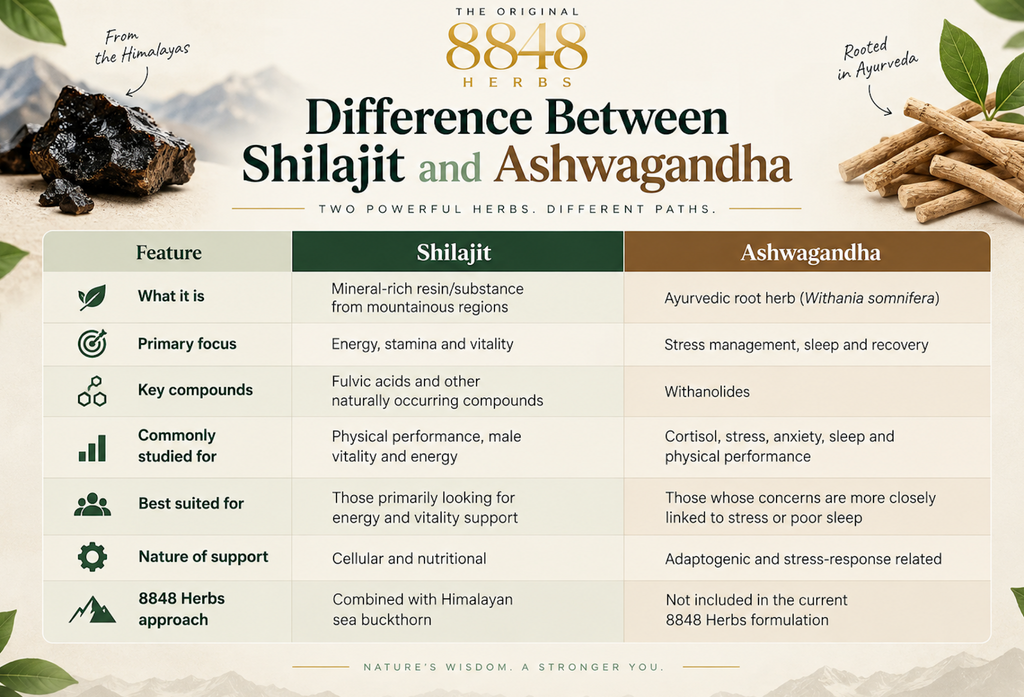
The Core Difference Between Shilajit and Ashwagandha
This is the distinction worth understanding before anything else.
Shilajit works bottom-up. It addresses cellular energy production, mineral availability, and mitochondrial efficiency. Think of it as upgrading the engine, improving the fundamental machinery that produces energy at the cellular level. The effects are systemic and metabolic.
Ashwagandha works top-down. It addresses the hormonal and nervous system regulation that governs how the body responds to and recovers from stress. Think of it as recalibrating the control system and reducing the cortisol output that depletes energy, disrupts sleep, and suppresses testosterone over time.
Both improve energy and vitality. But they do it through entirely different pathways. That’s why choosing between them, or deciding to use both, depends on what’s actually driving your symptoms.
Shilajit vs Ashwagandha: Quick-Glance Difference
| Feature | Shilajit | Ashwagandha |
| What it is | Mineral-rich resin/substance from mountainous regions | Ayurvedic root herb (Withania somnifera) |
| Primary focus | Energy, stamina and vitality | Stress management, sleep and recovery |
| Key compounds | Fulvic acids and other naturally occurring compounds | Withanolides |
| Commonly studied for | Physical performance, male vitality and energy | Cortisol, stress, anxiety, sleep and physical performance |
| Best suited for | Those primarily looking for energy and vitality support | Those whose concerns are more closely linked to stress or poor sleep |
| Nature of support | Cellular and nutritional | Adaptogenic and stress-response related |
| 8848 Herbs approach | Combined with Himalayan sea buckthorn | Not included in the current 8848 Herbs formulation |
Shilajit: What It Does Best
Cellular Energy and Mitochondrial Function
Fulvic acid in shilajit supports the electron transport chain, the process by which mitochondria produce ATP, the cell’s primary energy currency. More efficient mitochondrial function means more available energy for physical activity, cognitive work, and general daily function.
This is the most direct and well-supported mechanism behind shilajit’s reputation as an energy tonic. It’s not stimulant energy but the quieter, more sustained energy that comes from cells working more efficiently.
Mineral Delivery and Bioavailability
Most people know they need minerals. Fewer people realise that mineral absorption is often the limiting factor and not the intake. Fulvic acid acts as a natural chelator, binding minerals to organic molecules that the body absorbs more readily than inorganic mineral salts.
This is why shilajit is sometimes described as amplifying the effect of other nutrients taken alongside it. It genuinely improves how the body uses what it’s given.
Testosterone Support
Several clinical trials have looked at shilajit’s effect on testosterone levels in men, particularly those with low baseline scores. The results show modest but meaningful improvements with consistent use over 90 days. Actually, the mechanism is thought to involve both direct effects on luteinizing hormone and indirect effects through improved mitochondrial function in testicular cells.
Cognitive Clarity
Fulvic acid has antioxidant properties that are specifically relevant to brain tissue, which is particularly vulnerable to oxidative stress. Some research has looked at shilajit’s potential role in supporting cognitive function and reducing markers of neurodegeneration, though this remains an emerging area.
Ashwagandha: What It Does Best
Cortisol Reduction and Stress Management
This is ashwagandha’s strongest evidence base. Multiple randomised controlled trials have shown significant reductions in serum cortisol with consistent ashwagandha supplementation over 8 to 12 weeks. The effect size is meaningful and not marginal.
Lower cortisol has cascading downstream effects: better sleep quality, improved testosterone environment, reduced inflammatory markers, and better mood regulation. A lot of what ashwagandha is credited with is actually the downstream result of cortisol reduction rather than a direct effect on those systems.
Sleep Quality
Ashwagandha contains a compound called triethylene glycol in its leaf, and withanolides in its root, both of which have been studied for their role in supporting sleep onset and sleep quality. Clinical trials specifically focused on sleep have produced consistently positive results.
This matters for stamina and energy more than most people give it credit for. Poor sleep is one of the most direct suppressors of testosterone, growth hormone, and physical recovery. Improving sleep quality through ashwagandha creates a better hormonal environment for everything else.
Anxiety and Mood
Ashwagandha’s anxiolytic effects include its ability to reduce anxiety. Multiple trials have shown improvements in self-reported anxiety scores alongside the cortisol reductions. The mechanism involves modulation of GABA receptors in the brain, similar in principle (though not in potency) to how some anti-anxiety medications work.
Physical Performance
Studies involving physically active adults have shown improvements in VO2 max, muscle recovery, and strength output with ashwagandha supplementation. These effects are largely downstream of cortisol reduction. So, lower cortisol means better anabolic environment, faster recovery, and more consistent training adaptation.
Which Is Better: Shilajit or Ashwagandha?
Here’s the honest answer: neither is universally better. The right choice depends on what’s actually happening in your body.
Choose shilajit if: Your energy feels depleted at a fundamental level and not stress-related, but a deep physical fatigue that doesn’t resolve with rest, or
- You’re dealing with poor mineral absorption, low physical stamina, or cognitive fog, or
- You want to support testosterone and reproductive health directly, or
- You’re physically active and want to support cellular energy production and recovery.
Choose ashwagandha if: Your energy depletion is clearly stress-driven, or
- You’re not sleeping well, you’re anxious, you feel wired but tired, or
- You’re in a sustained high-pressure period, or
- Your cortisol is likely elevated and suppressing your natural vitality, or
- You want to address the hormonal root cause rather than work around it.
Consider both if: You’re dealing with chronic fatigue that has both components: depleted cellular energy AND a dysregulated stress response. This is actually common. Chronic stress depletes minerals and mitochondrial function over time, which means the cortisol problem and the cellular energy problem often exist simultaneously.
The two herbs don’t compete. They just work on different systems and tend to complement each other when both are genuinely indicated.
8848 Herbs: Shilajit and Sea Buckthorn Together
There’s a third ingredient worth bringing into this conversation, one that complements both shilajit and ashwagandha in ways that round out the vitality picture.
8848 Herbs has developed a Shilajit-infused sea buckthorn juice that pairs high-altitude Himalayan shilajit with wild-harvested sea buckthorn from Ladakh. The combination is nutritionally logical.
Shilajit addresses cellular energy, mineral bioavailability, and mitochondrial function (the bottom-up energy pathway). Sea buckthorn addresses the broader nutritional environment: vitamin C for immune function and collagen synthesis, carotenoids for antioxidant protection, omega-7 for skin and mucosal integrity, and the complete omega-3, 6, 7, 9 fatty acid profile for systemic anti-inflammatory support.
The two work on different layers. Shilajit goes deep into cellular machinery while the Sea buckthorn provides the broad nutritional density that supports everything above it. Together, they cover more of the vitality picture than either does alone, and neither requires ashwagandha to do its job even though ashwagandha addresses the stress-hormone layer that both leave untouched.
If you’re dealing with stress-driven depletion, a combination of ashwagandha for cortisol regulation alongside shilajit-infused sea buckthorn juice for cellular and nutritional replenishment addresses all three layers simultaneously: hormonal regulation, cellular energy, and broad-spectrum nutritional support.
Full product details for 8848’s Shilajit-infused sea buckthorn juice will be available at launch.
How to Take Each One
Shilajit: Standard supplemental doses range from 300 to 500 mg of purified resin per day. Take with warm water or milk. Consistent daily use over 6 to 8 weeks is the minimum to evaluate effect. Don’t exceed recommended doses because more isn’t better.
Ashwagandha: Most clinical trials use between 300 and 600 mg of root extract standardised to withanolide content. Morning or evening use both work. Some people find it mildly sedating and prefer evening dosage. Again, 8 to 12 weeks of consistent use is where meaningful results show up.
Both together: No significant interaction concerns have been documented. Taking them together is common in traditional Ayurvedic formulations. Start with standard doses of each rather than doubling up.
Medication interactions: Both herbs can interact with thyroid medication, immunosuppressants, and sedatives. If you’re on any prescription medication, check with your doctor before adding either.
FAQs
Can I take shilajit and ashwagandha together every day?
Yes, and traditional Ayurvedic practice has combined them for centuries. They work on different systems and don’t compete. Start at standard doses of each and take 8 to 12 weeks before evaluating.
Which one works faster?
Neither produces dramatic immediate effects. Both are adaptogenic and nutritive rather than stimulant in nature. Ashwagandha tends to show sleep and anxiety improvements slightly earlier, often within 2 to 4 weeks, whereas Shilajit’s energy and physical performance effects typically emerge more gradually over 6 to 8 weeks.
Is shilajit or ashwagandha better for men specifically?
Both have male-relevant applications. Shilajit has stronger direct evidence for testosterone support, whereas Ashwagandha has stronger evidence for cortisol reduction and the downstream testosterone benefits that it produces. For men dealing with stress-related testosterone suppression, ashwagandha addresses the root cause more directly. And for men with low physical energy and poor stamina independent of stress, shilajit is the stronger choice.
Are there any side effects?
Ashwagandha is generally well-tolerated. Some people experience mild digestive upset initially. It’s contraindicated in pregnancy and should be used cautiously with thyroid conditions. Shilajit in recommended doses from purified sources is safe for most adults. Unpurified shilajit is the concern, and not the ingredient itself. Heavy metal testing documentation from the brand is non-negotiable.
The Bottom Line
Shilajit vs ashwagandha isn’t a competition. They’re two different tools for two different problems that often coexist.
While shilajit optimises cellular energy, mineral absorption, and mitochondrial function, ashwagandha targets stress hormone regulation, sleep quality, and the broader endocrine environment essential for physical vitality. The difference between shilajit and ashwagandha is the difference between upgrading the engine and fixing the control system.
First, know which problem you’re actually dealing with, and then use the right tool for it before giving it enough time to work. That’s the whole framework.