Table of Contents
- What Is Pure Shilajit and Why Does It Matter?
- How to Identify Pure Shilajit: 7 Practical Tests
- The Solubility Test
- The Temperature Test
- The Flame Test
- The Smell Test
- The Purity Marker: Fulvic Acid Content
- The Packaging and Provenance Test
- The Price Reality Check
- Fake vs Real Shilajit: The Most Common Adulterants
- Is Shilajit Safe to Take Every Day?
- 8848 Herbs: Shilajit Meets Sea Buckthorn
- Best Shilajit in India: What to Actually Look For
- The Bottom Line
- FAQs
Quick Summary
Pure Shilajit and fake/adulterated Shilajit can look similar, but their composition, purity and quality can differ significantly. This guide explains the key differences and practical checks to identify authentic Shilajit, while showing how 8848 Herbs combines Shilajit with Sea Buckthorn for everyday vitality and wellness.
The pure shilajit market has a serious problem. For every legitimate product on the shelf, there are several that are diluted, synthetic, or outright fake. And most people buying shilajit have no idea how to tell the difference.
That’s not their fault because the fakes are getting better. The marketing language is nearly identical across genuine and counterfeit products, while the consequences of buying the wrong thing range from wasting money to consuming something genuinely harmful.
This guide exists to fix that with seven concrete, testable ways to verify what you’re actually buying before it goes into your body.
What Is Pure Shilajit and Why Does It Matter?
Before getting into verification, it’s ideal to be clear about what pure shilajit actually is.
Shilajit is a resinous mineral compound that forms over centuries in high-altitude mountain rocks, primarily in the Himalayas, Altai, and Caucasus ranges. It’s the result of organic plant matter, primarily Euphorbia and other high-altitude species, being compressed under geological pressure over hundreds to thousands of years. The result is a dense, tar-like resin that seeps from rock faces during warmer months.
Its primary active component is fulvic acid, complemented by humic acid and over 80 essential trace minerals, including iron, magnesium, zinc, and copper. This unique chemical profile explains why pure Himalayan shilajit has served as a foundational tonic for vitality in Ayurvedic practice for centuries and why modern scientific research actively investigates its impact on mitochondrial function, testosterone production, and cognitive health.
But here’s the problem. None of that applies to a fake or heavily adulterated product. A shilajit resin cut with molasses, brown sugar, or soil extract looks similar, tastes similar, and will be marketed with identical language. You get none of the active compounds and potentially something harmful instead.
The difference between real and fake shilajit isn’t cosmetic. It’s the entire point of the product.
How to Identify Pure Shilajit: 7 Practical Tests
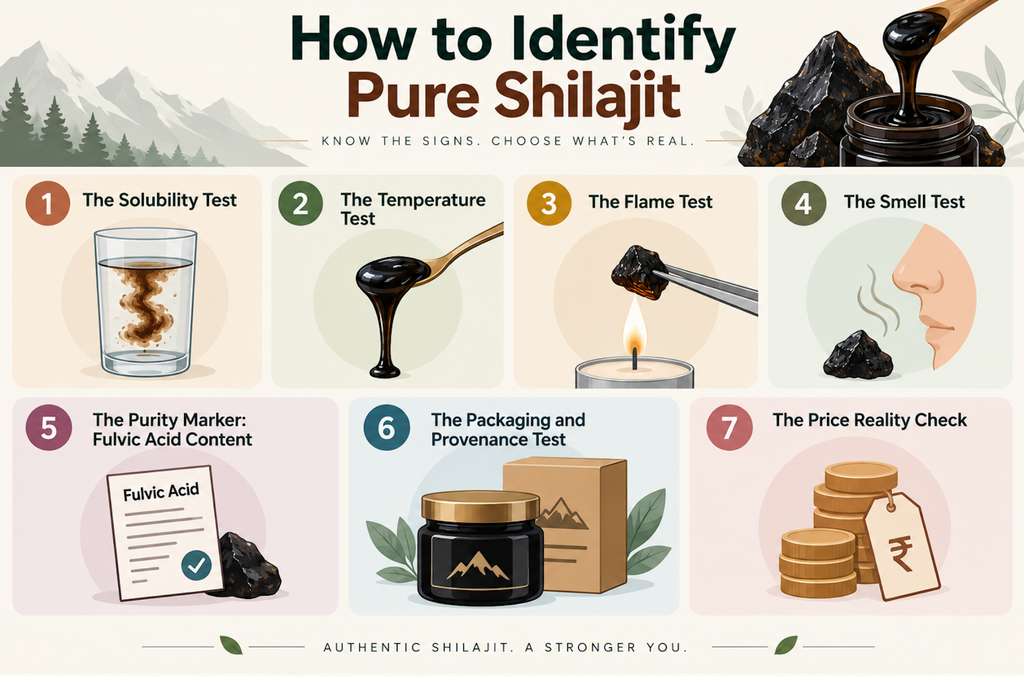
1. The Solubility Test
Pure shilajit dissolves completely in warm water or warm milk, turning the liquid a rich golden-brown or reddish-brown colour. There should be no residue, no floating particles, and no separation after stirring.
Fake shilajit often doesn’t dissolve fully. You’ll see clumps, sediment, or an oily film on the surface. Some adulterants dissolve but leave a distinctly different colour, i.e. very dark black rather than warm brown, or a murky, opaque liquid.
Test it: drop a small amount into a glass of warm (not boiling) water and stir. If it doesn’t dissolve cleanly and completely, that’s a red flag.
2. The Temperature Test
This is one of the most reliable physical tests for pure shilajit resin. Authentic shilajit is thermosensitive, as it behaves differently at different temperatures.
At room temperature or cooler, pure shilajit is firm, almost brittle. It should break rather than stretch or bend. When warmed in your hands or at body temperature, it becomes soft and pliable, almost like thick tar.
Fake shilajit made from artificial binders or gum resins tends to remain uniformly pliable regardless of temperature. It won’t go brittle when cooled because it doesn’t have the same mineral matrix that creates that behaviour in authentic resin.
Test it: refrigerate a small amount for 15 minutes. Authentic resin will become hard and crack under pressure. Room temperature product that remains soft and stretchy regardless of cooling is suspect.
3. The Flame Test
Pure shilajit doesn’t burn. It won’t catch fire or produce a flame when exposed to a lighter or match. It may bubble or smoke slightly when heat is applied directly, but it won’t ignite.
Adulterated shilajit containing organic fillers like wax, resin binders, and plant extracts used as bulking agents often catches fire or burns with a visible flame.
This test is straightforward and needs no equipment other than a lighter, as it’s one of the quickest ways to identify obvious adulteration.
4. The Smell Test
Authentic pure shilajit has a distinctive smell. It’s earthy, mineral, and slightly bitter, often described as similar to wet soil or aged organic matter. It’s not pleasant in a conventional sense, but it’s recognisable and consistent.
Fake shilajit is often doctored with flavouring agents to mask the smell of inferior ingredients. If your shilajit smells strongly sweet, chemical, or artificially earthy – as if the scent has been added rather than being inherent to the resin – that’s a meaningful warning sign.
Authenticity in this case smells like exactly what shilajit is: ancient compressed organic matter from a high-altitude mountain environment. It doesn’t smell like vanilla, caramel, or anything pleasant.
5. The Purity Marker: Fulvic Acid Content
This one requires more than a home test, but it’s the most important quality marker to look for on a label or certification document.
Fulvic acid is the primary active compound in shilajit. In high-quality pure shilajit, fulvic acid content typically ranges from 60% to 80% in standardised extracts. Products that don’t disclose fulvic acid content on their label, or that list it below 40%, are either not standardised or not particularly potent.
A reputable brand should have third-party lab testing that specifies fulvic acid percentage. If a brand can’t produce that documentation when asked, treat that as a red flag equivalent to a failed physical test.
6. The Packaging and Provenance Test
Authentic pure Himalayan shilajit comes from specific, traceable regions. Legitimate brands can tell you exactly where their shilajit is sourced: which mountain range, which altitude range, and which collection method.
Vague claims like “Himalayan shilajit” without any further sourcing specificity are increasingly common among counterfeit and low-grade products. The Himalayan range spans thousands of kilometres across multiple countries. The word “Himalayan” without further detail tells you almost nothing about what you’re actually getting.
Similarly, authentic products are processed using purification methods that remove heavy metals and contaminants naturally present in raw shilajit. Unpurified raw shilajit shouldn’t be consumed as it contains free radicals and heavy metals that the purification process removes. If a brand is marketing “raw, unprocessed shilajit” as a selling point, that’s actually a concern rather than a quality indicator.
Check for: specific sourcing region, altitude of collection, purification method, and heavy metal testing documentation.
7. The Price Reality Check
Pure shilajit is expensive to source and process responsibly. The collection process is seasonal and manual, as it can only be harvested during specific months when it seeps from rock faces. Purification requires controlled processing to remove contaminants. Quality third-party lab testing adds to cost.
A product selling genuine pure shilajit at a very low price point is either cutting corners on purification, sourcing inferior material, or selling you something that isn’t shilajit at all.
This doesn’t mean the most expensive product is automatically the best. But if a price looks too good to be true for a product claiming to be premium Himalayan shilajit, it almost certainly is.
Fake vs Real Shilajit: The Most Common Adulterants
Knowing what’s commonly used to fake shilajit helps you understand what you’re actually testing for.
| Common Adulterant | Why It’s Used | How It Differs from Pure Shilajit |
| Molasses & Brown Sugar | Replicates the dark colour and sticky texture of shilajit resin | May not dissolve cleanly and can behave differently when exposed to temperature changes |
| Soil & Mineral Powders | Adds weight and creates a mineral-like appearance | Can leave residue when dissolved and does not provide the natural compound profile of genuine shilajit |
| Humic Acid Alone | Sold as a cheaper alternative because humic acid is naturally present in shilajit | Humic acid alone does not represent the complete composition of shilajit resin |
| Synthetic Fulvic Acid | Used as a cheaper substitute while allowing products to claim fulvic acid content | Produced through a different process and does not have the same composition as naturally occurring shilajit-derived compounds |
Is Shilajit Safe to Take Every Day?
For healthy adults, pure shilajit at standard supplemental doses is generally considered safe for daily use. Traditional Ayurvedic practice has used it as a daily tonic of vitality for centuries, and modern safety studies haven’t identified significant concerns at recommended doses.
A few important caveats:
Heavy metal content in unpurified products. Raw, unprocessed shilajit contains heavy metals that must be removed through proper purification. Only consume shilajit from brands that provide heavy metal testing on record. This is non-negotiable, period!
Medication interactions. Shilajit may interact with medications for diabetes, blood pressure, and blood thinning. If you’re on any prescription medication, speak to your doctor before adding shilajit to your daily routine.
Dosage. More isn’t better with shilajit. Standard supplemental doses range from 300 to 500 mg per day for resin forms. Exceeding this doesn’t amplify benefits and increases the risk of side effects.
Pregnancy and breastfeeding. There isn’t sufficient clinical data to establish safety during pregnancy or breastfeeding. Avoid supplemental use during these periods.
Start gradually. Beginning with a smaller dose and building up over one to two weeks lets you monitor your body’s response before committing to a full daily dose.
8848 Herbs: Shilajit Meets Sea Buckthorn
Understanding what makes pure shilajit worth buying is one side of the equation. The other is finding a formulation that pairs it intelligently with complementary ingredients.
8848 Herbs has developed a Shilajit-infused sea buckthorn juice that brings these two high-altitude Himalayan ingredients together in a single daily format, and the combination makes genuine nutritional sense.
Here’s why these two ingredients work well together:
Shilajit contributes fulvic acid and trace minerals, the compounds that support mitochondrial energy production, mineral absorption, and cellular function. Its natural strengths are deep, systemic, and fat-soluble.
Sea buckthorn juice brings an entirely different and complementary profile. It’s one of the richest plant sources of vitamin C, delivering water-soluble antioxidant and immune support. Its carotenoid content adds further antioxidant density. The omega fatty acid profile, including the rare omega-7, supports skin health, mucosal integrity, and anti-inflammatory function.
Together, the combination addresses energy and vitality at the cellular level through shilajit, while sea buckthorn delivers broad-spectrum nutritional support through vitamins, fatty acids, and antioxidants that shilajit alone doesn’t provide.
Both ingredients are native to the same high-altitude Himalayan environment. Both are sourced wild rather than farmed at scale and are traditionally associated with vitality and resilience in the communities that have lived alongside them for centuries.
For men, the benefits of sea buckthorn juice align closely with the vitality and stamina goals typically associated with shilajit. By offering robust energy metabolism, antioxidant protection, and high nutritional density in a single daily serving, it streamlines daily supplementation without the need to manage multiple products.
This is what a thoughtfully formulated product looks like: two ingredients with distinct, complementary mechanisms, combined in a format that’s practical to take daily.
Full product details for 8848’s Shilajit-infused sea buckthorn juice will be available at launch. Watch this space.
Best Shilajit in India: What to Actually Look For
Summarising the verification framework into a practical buying checklist:
- Fulvic acid content disclosed and above 60% for standardised extracts
- Third-party lab testing available, including heavy metal screening
- Specific sourcing region and altitude stated, not just “Himalayan”
- Purification method explained, not marketed as raw or unprocessed
- Passes solubility, temperature, and flame tests at home
- Price reflects the genuine cost of responsible sourcing and processing
- AYUSH certification for products making Ayurvedic claims in India
No single marker is sufficient on its own. A product that passes the home tests but has no lab documentation is still a risk; a product with impressive-looking certifications that fails the solubility test in your kitchen is telling you something important.
Use the full checklist. Not just the parts that are convenient.
The Bottom Line
The pure shilajit market rewards informed buyers and takes advantage of everyone else. The seven verification methods in this guide are solubility, temperature, flame, smell, fulvic acid documentation, sourcing provenance, and price reality. These will give you a complete framework for separating genuine product from the fakes flooding the market.
Pure Himalayan shilajit is worth buying when it’s real. It has a strong traditional track record and increasingly solid modern research behind it. But none of that applies to an adulterated product in authentic-looking packaging.
Test before you trust. Ask for documentation. And if a brand can’t answer basic questions about where their shilajit comes from and how it’s purified, you know the rest.
FAQs
Can women take shilajit too?
Yes. Most of the research on shilajit doesn’t limit its relevance to men. The energy, antioxidant, and cognitive support properties are relevant regardless of sex. The testosterone-related research is specific to men, but that’s one application among several. The standard pregnancy and breastfeeding caution applies.
What does sea buckthorn juice add for women specifically?
Sea buckthorn juice benefits for skin nourishment, immune support, and digestive health are particularly relevant for women. The vitamin C, carotenoids, and omega-7 fatty acid content support skin elasticity, collagen synthesis, and mucosal integrity — all areas where women’s nutritional needs are well-documented.
How long before pure shilajit produces noticeable effects?
Most people report noticeable changes in energy and general vitality after four to six weeks of consistent daily use. Noticeable improvements in cognitive clarity generally take longer. Expecting immediate results within a week is unrealistic; shilajit restores underlying cellular systems rather than acting as a quick-fix stimulant.
Is the resin form better than powder or capsules?
Generally yes, for potency and bioavailability. Resin remains the least processed form, preserving the most complete profile of active compounds. While capsules and powders can be legitimate alternatives, their efficacy depends heavily on extract quality. If opting for capsules, always verify that the exact fulvic acid content is explicitly stated on the label.
What makes best pure shilajit in India different from international sources?
Himalayan shilajit sourced from high-altitude Indian regions, particularly Ladakh and the upper Himalayas, is considered among the highest quality globally due to the specific geological and botanical conditions of those areas. The altitude, rock composition, and plant species present during formation all affect the final compound profile. Indian-sourced, properly purified shilajit from a traceable origin is genuinely different from lower-altitude or poorly sourced alternatives.