

Table of Contents
- What Is Himalayan Sea Buckthorn?
- The Science of Altitude: Why High-Altitude Plants Are Different
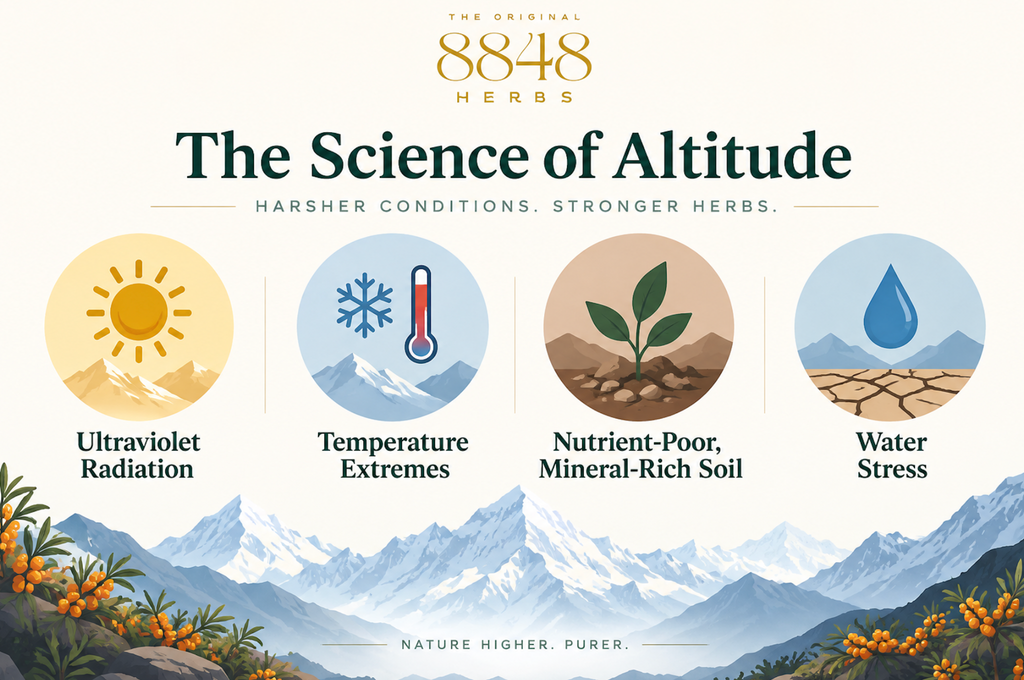
- Ultraviolet Radiation
- Temperature Extremes
- Nutrient-Poor, Mineral-Rich Soil
- Water Stress
- Sea Buckthorn Nutrition at Altitude: What’s Actually Different
- Sea Buckthorn Plant Benefits: Why This Matters for You
- Why 8848 Herbs Sources from the Himalayas
- How to Get the Most from Himalayan Sea Buckthorn
- The Bottom Line
- FAQs
Quick Summary
Himalayan Sea Buckthorn differs from lowland varieties because the extreme conditions at high altitudes, including stronger UV exposure, temperature fluctuations and water stress, can influence the plant’s production of protective nutrients and bioactive compounds. This guide explains how altitude and sourcing can affect Sea Buckthorn’s nutritional profile and why 8848 Herbs uses high-altitude Himalayan Sea Buckthorn in its wellness formulations.
Not all sea buckthorn is the same. That’s not a marketing line but plant biology.
Himalayan sea buckthorn grown at high altitudes produces a measurably different nutritional profile than the same species grown at lower elevations or in controlled agricultural conditions. The gap isn’t marginal. In some compounds, it’s significant enough to matter in any serious conversation about quality and potency.
Understanding why requires a quick look at how plants actually respond to their environment. Once you understand the mechanism, the altitude argument stops being a branding claim and starts being straightforward science.
What Is Himalayan Sea Buckthorn?
Sea buckthorn (Hippophae rhamnoides) is a thorny, nitrogen-fixing shrub native to cold, arid regions across Europe and Asia. In India, it grows wild across the high-altitude landscapes of Ladakh, Spiti, Kinnaur, and parts of Himachal Pradesh and Uttarakhand, often between 2,500 and 4,500 metres above sea level.
The plant is extraordinary in its adaptability:
- It grows in rocky, nutrient-poor soil where most plants can’t survive, tolerating temperatures as low as minus 40 degrees Celsius.
- It fixes its own nitrogen, which means it doesn’t need fertile soil to thrive.
- It’s been growing in these conditions for thousands of years, and those conditions are precisely what make it valuable.
The berries are small, bright orange, and intensely tart. They’re harvested once a year, typically between September and November, when the fruit is at peak ripeness. In Ladakh and the broader Himalayan region, this is still done by hand; the thorns make mechanical harvesting impractical at scale.
Traditional communities across Ladakh, Tibet, and the Himalayan foothills have used sea buckthorn for food, medicine, and skin care for centuries. What modern nutritional science has done is provide a clearer picture of why those traditional uses were well-founded.
The Science of Altitude: Why High-Altitude Plants Are Different
This is the core argument, and it deserves a proper explanation rather than a tagline.
Plants produce some protective compounds like antioxidants, flavonoids, carotenoids, and fatty acids as a response to environmental stress. This is called the hormetic stress response. The harsher the environment, the more of these compounds the plant produces to survive it.
High altitude creates multiple simultaneous stressors that lowland environments simply don’t.
Ultraviolet Radiation
UV radiation increases significantly with altitude. At sea level, the atmosphere filters out a substantial portion of incoming UV radiation. At 3,500 metres, that filtration is dramatically reduced. Plants at high altitude are exposed to UV levels that would damage or kill lowland species.
Sea buckthorn survives this by producing carotenoids and flavonoids in much higher concentrations than its lowland counterparts. These compounds absorb and neutralise UV radiation at the cellular level. The plant is essentially producing its own sunscreen, and when you consume the berry, those same protective compounds work as antioxidants in your body.
Himalayan sea buckthorn berries contain significantly higher carotenoid levels than those cultivated at lower altitudes. The berry’s vibrant orange hue serves as a direct visual indicator of this exceptional nutrient density. High-altitude Himalayan berries tend to be a deeper, more saturated orange than lowland-grown fruit, a difference you can often see before any lab test confirms it.
Temperature Extremes
Himalayan sea buckthorn experiences temperature swings that lowland plants don’t. Warm days and extremely cold nights, particularly in Ladakh, force the plant to produce more cold-protective fatty acids to maintain cell membrane integrity.
This is directly relevant to the omega fatty acid profile of the berry. The omega-3, omega-6, omega-7, and omega-9 content of high-altitude sea buckthorn is associated with the plant’s need to keep cell membranes fluid at low temperatures. A plant that doesn’t experience these temperature extremes has less biological pressure to produce these fatty acids in the same concentrations.
Omega-7 (palmitoleic acid) deserves specific mention here. It’s rare in plant sources, and sea buckthorn is one of the few plants that contains it in meaningful amounts. Research has associated omega-7 with supporting skin membrane integrity, mucosal health, and cardiovascular function. The concentration of omega-7 in high-altitude Himalayan varieties reflects the plant’s adaptation to extreme cold.
Nutrient-Poor, Mineral-Rich Soil
This sounds like a contradiction, but it isn’t. The rocky, glacially derived soils of the high Himalayas are poor in organic nitrogen but rich in trace minerals: iron, potassium, calcium, magnesium, and others deposited by geological processes over millions of years.
Sea buckthorn is one of the few plants that can fix atmospheric nitrogen directly, so it doesn’t need soil nitrogen to grow. But it does absorb the soil’s mineral content. This is part of why Himalayan sea buckthorn has a notably dense mineral profile, as the plant draws from a mineral-rich glacial substrate that lowland agricultural soils don’t replicate.
Water Stress
High-altitude environments in regions like Ladakh are cold deserts with very low rainfall, high evaporation, and limited water availability. Water stress is another known trigger for increased production of protective plant compounds.
Plants under water stress produce higher concentrations of antioxidants as a survival mechanism. This contributes further to the antioxidant density that makes high-altitude sea buckthorn antioxidants a specific point of interest in nutritional research.
Sea Buckthorn Nutrition at Altitude: What’s Actually Different
Pulling these mechanisms together, here’s what the altitude effect produces in measurable nutritional terms.
Vitamin C: Sea buckthorn is already one of the richest plant sources of vitamin C globally. High-altitude varieties show concentrations significantly above what lowland-grown fruit produces, driven by the plant’s need to manage oxidative stress from UV radiation. Vitamin C is itself an antioxidant, and the plant produces more of it under higher UV load.
Carotenoids: Beta-carotene, lycopene, zeaxanthin, and other carotenoids are present in higher concentrations in high-altitude berries. These convert to vitamin A in the body and function as antioxidants in their own right. The visual indicator, i.e. deeper orange colour, reflects this directly.
Omega fatty acids: Driven partly as an adaptation to cold environments, high-altitude Himalayan sea buckthorn boasts a significantly higher concentration of omega – 3, 6, 7, and 9 fatty acids. This exceptional fatty acid profile makes its pulp and seed oils highly prized across both premium nutritional and cosmetic formulations.
Flavonoids and polyphenols: Quercetin, isorhamnetin, and other flavonoids are UV-protective compounds the plant produces in greater quantities under high-altitude UV stress. These have documented anti-inflammatory and antioxidant properties in human health research.
Vitamin E: Both tocopherols and tocotrienols are multiple forms of vitamin E present in higher concentrations in high-altitude fruit. Vitamin E works synergistically with vitamin C, and the combination in sea buckthorn is part of what makes its antioxidant profile unusual compared to most common fruits.
Sea Buckthorn Plant Benefits: Why This Matters for You
The altitude argument isn’t academic. It directly affects what you’re actually getting when you buy a sea buckthorn product.
A berry grown in a lowland agricultural setting at 200 metres, in nitrogen-rich fertilised soil, with regular irrigation is under none of the environmental pressures that drive compound production in Himalayan varieties. It’s the same species producing the same types of compounds. But the concentrations are different, and in nutritional supplementation, concentration is what matters.
This is why sourcing specificity is one of the most important when evaluating any sea buckthorn product. “Sea buckthorn” on a label tells you the species. It doesn’t tell you where it was grown, at what altitude, under what conditions, or how the harvested fruit was processed.
High altitude sea buckthorn benefits are real, but they’re only accessible through products sourced from actual high-altitude environments. A product that can’t tell you where its sea buckthorn comes from is a product that may not be sourcing from the conditions that produce the nutritional profile you’re paying for.
Why 8848 Herbs Sources from the Himalayas
The name 8848 is a direct reference to 8,848 metres, the height of Everest, the highest point on Earth, and the symbol of the extreme Himalayan environment that defines the brand’s sourcing philosophy.
8848 Herbs sources sea buckthorn from the wild, high-altitude landscapes of Ladakh and the greater Himalayan region, the same conditions described throughout this article. This is neither farmed at scale nor grown at a lower altitude for easier access. Wild-harvested from the environment that produces the compound density that makes the ingredient worth using.
The Himalayan sourcing isn’t a marketing backdrop. It’s the entire nutritional argument for why the product is formulated around this specific ingredient from this specific region.
When you’re evaluating sea buckthorn from the Himalayas as a daily nutritional input, the questions worth asking are: Where exactly was it grown? At what altitude? Was it wild-harvested or farmed? How was it processed after harvest? These aren’t difficult questions for a brand with genuine sourcing standards to answer.
8848 Herbs answers them directly.
How to Get the Most from Himalayan Sea Buckthorn
A few practical points worth knowing:
Juice or pulp for water-soluble nutrients: Vitamin C, B vitamins, polyphenols, and minerals are accessible through juice or pulp forms. These are water-soluble compounds that don’t require fat for absorption.
Oil for fat-soluble compounds: Carotenoids, vitamin E, and omega fatty acids are fat-soluble. Sea buckthorn oil from pulp or seed is the most efficient delivery format for these. Taking oil with a meal containing some dietary fat improves absorption.
Consistency over quantity: Daily intake over several weeks produces more meaningful results than large sporadic doses. The antioxidant and nutritional support from sea buckthorn works cumulatively, not acutely.
Storage matters: Vitamin C is heat and light-sensitive. Store sea buckthorn juice refrigerated, away from direct light, and consume within the timeframe specified on packaging.
The Bottom Line
The potency of Himalayan sea buckthorn isn’t a claim that needs to be taken on faith. It’s the predictable output of straightforward plant biology, a species under significant environmental stress producing higher concentrations of protective compounds to survive it.
Altitude matters. Sourcing matters. The conditions a plant grows in are directly reflected in what ends up in the berry, and in what ends up in your body when you consume it.
That’s the science of 8,848 metres. And it’s why where your sea buckthorn comes from is as important as the fact that you’re taking it at all.
FAQs
Is Himalayan sea buckthorn better than other varieties?
From a nutritional density standpoint, yes, for the reasons covered in detail above. The altitude, UV exposure, temperature extremes, and mineral-rich soil of the Himalayan growing environment drive higher concentrations of the compounds that make sea buckthorn nutritionally valuable. Same species, meaningfully different profile.
What makes high-altitude sea buckthorn antioxidants different?
The antioxidant compounds in sea buckthorn – carotenoids, flavonoids, vitamin C, and vitamin E – are produced by the plant as a stress response. Higher UV radiation, colder temperatures, and water stress at altitude mean the plant produces more of these compounds than it would under easier growing conditions. You’re getting the concentrated output of a plant that had to work harder to survive.
Why is sea buckthorn from the Himalayas harvested by hand?
The thorny nature makes mechanical harvesting impractical, particularly on rocky high-altitude terrain. Hand harvesting is slower and more expensive, but it also means the fruit is handled more carefully and harvested at peak ripeness rather than on an industrial schedule. It’s a quality indicator and a logistical reality.
Can I take Himalayan sea buckthorn every day?
Yes, for most healthy adults at standard supplemental doses. Its robust nutritional profile, rich in vitamins, fatty acids, minerals, and antioxidants, makes it an ideal input for daily baseline wellness. However, due to its high acidity, anyone with a sensitive stomach or acid reflux should dilute liquid formulations and begin with a smaller initial dose.
Keep reading
All Sea Buckthorn Science →- Sea Buckthorn Science Complete Guide to Sea Buckthorn: Benefits, Uses, Nutrition & Side Effects 12 min read
- Ingredient Education Omega-3 Benefits: How It Supports Heart, Brain, Skin and Overall Health 15 min read
- Wellness & Nutrition Premature Ejaculation: Causes, Symptoms and Treatment Options Explained 11 min read