

Table of Contents
- What Relationship Intimacy Actually Means
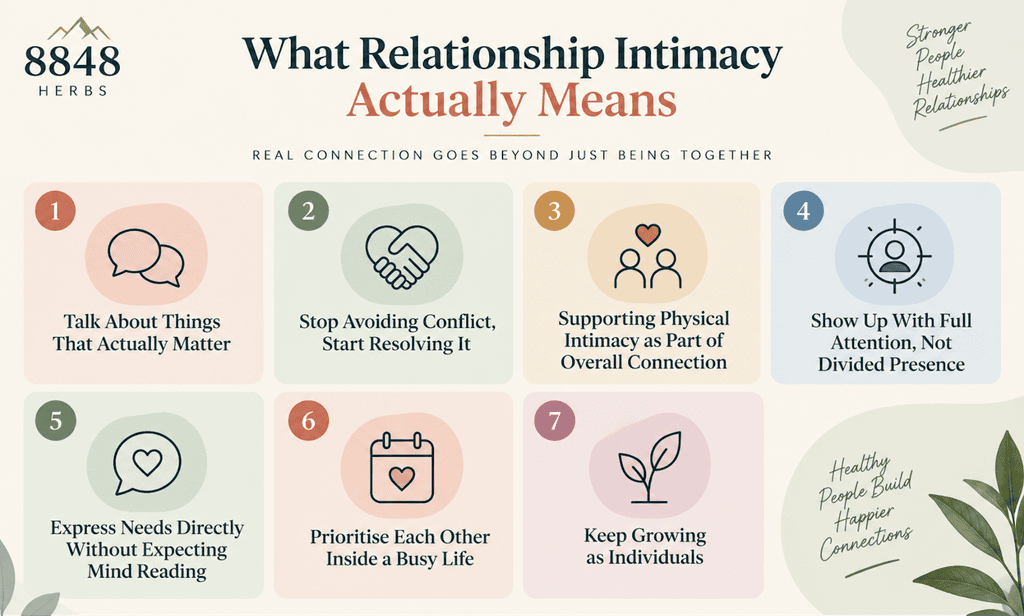
- Habit 1: Talk About Things That Actually Matter
- Habit 2: Stop Avoiding Conflict, Start Resolving It
- Habit 3: Supporting Physical Intimacy as Part of Overall Connection
- Habit 4: Show Up With Full Attention, Not Divided Presence
- Habit 5: Express Needs Directly Without Expecting Mind Reading
- Habit 6: Prioritise Each Other Inside a Busy Life
- Habit 7: Keep Growing as Individuals
- The Bottom Line
- FAQs
Quick Summary
Strong relationship intimacy is built through everyday habits such as honest communication, quality time, affection and emotional presence. For physical intimacy, addressing concerns around sexual confidence and stamina can also help couples feel more connected, with options such as 8848 Herbs’ Organic Delay Cream offering targeted support for men.
Relationship intimacy is not a feeling you stumble into. It is something you build, maintain, and sometimes fight for. Yet most couples treat it like a passive byproduct of being together, assuming that love alone will keep closeness alive, but it will not. Intimacy requires deliberate habits, consistent effort, and the willingness to be genuinely uncomfortable sometimes.
If your relationship feels distant, flat, or like two people just managing logistics together, the habits below are not optional reading. They are exactly where the work starts.
What Relationship Intimacy Actually Means
Most people narrow intimacy down to physical closeness. That is a partial picture and a costly mistake. True relationship intimacy spans emotional, intellectual, physical, and even spiritual dimensions. It is the feeling of being fully known by another person and choosing to stay anyway.
Emotional intimacy is the foundation. Without it, physical closeness becomes hollow and intellectual connection stays surface-level. Healthy relationships are built on a layered understanding of each other, not just shared history or shared routines.
This matters because couples often treat symptoms without addressing the root. They plan date nights to get rid of the distance without asking why the distance appeared in the first place. Solving for intimacy wellness means looking at the whole system, not patching one part of it.
Habit 1: Talk About Things That Actually Matter
The average couple spends most of their verbal energy on logistics. Who picks up the kids? What is for dinner? Did you pay that bill? This kind of communication is necessary, but it is not intimacy. It is maintenance.
How does communication affect intimacy? Directly and significantly. Research consistently shows that couples who engage in deeper, self-disclosing conversations report higher relationship satisfaction. Vulnerability is the mechanism. When you share fears, ambitions, disappointments, and uncertainties, you create the conditions for genuine closeness.
The fix is not complicated, but it requires intention. Set aside conversation time that has nothing to do with tasks. Ask real questions like “What is something you have been thinking about a lot this week?” This lands completely differently than “How was your day?”
If your default conversations stay shallow, your relationship will too. That is not pessimism, but how emotional intimacy works.
Habit 2: Stop Avoiding Conflict, Start Resolving It
Conflict avoidance is one of the most reliable intimacy killers in long-term relationships. When couples sidestep tension to preserve short-term peace, they accumulate unresolved resentment that erodes closeness over time.
Healthy relationships are not conflict-free; they are conflict-competent. The difference is not about disagreements arising but how couples engage with them. Stonewalling, deflection, and passive withdrawal create emotional distance far more effectively than any argument ever could.
Repair matters more than perfection. Couples who can fight, acknowledge what went wrong, and genuinely reconnect afterwards build stronger intimacy than couples who suppress conflict entirely. Pretending everything is fine is not emotional safety. It is emotional avoidance wearing a calm face.
Habit 3: Supporting Physical Intimacy as Part of Overall Connection
Physical intimacy is only one part of a healthy relationship, but it can still play an important role in how couples experience closeness. If sexual confidence, stamina or performance concerns are affecting intimacy, addressing those concerns openly can be just as important as working on communication and emotional connection.
This is where products designed specifically for men’s sexual wellness can have a role. 8848 Herbs Organic Delay Cream, for example, is formulated as a topical herbal option for men who want support with lasting longer during intimacy. Its formulation includes botanical ingredients such as saffron, nutmeg, clove and cinnamon, offering a different approach from products focused on general energy or everyday wellness.
Of course, a product cannot replace communication, affection or emotional connection. It can simply be one part of a broader approach to intimacy, alongside understanding your partner, discussing expectations and feeling comfortable talking about what works for both of you.
Habit 4: Show Up With Full Attention, Not Divided Presence
Being physically present while mentally elsewhere is one of the most underrated forms of disconnection in modern relationships. Phones, work stress, and mental load fragment attention in ways that quietly damage intimacy over time.
Emotional intimacy requires presence. Well, not perfect presence, but genuine presence in the moments that count. When your partner is sharing something important, and you are half-listening, you are basically communicating that your attention is more valuable than their experience. They register this even if they do not say it.
Create specific windows of undivided attention. It does not need to be hours. Twenty minutes of actual engagement is worth more than an evening of parallel distraction.
Habit 5: Express Needs Directly Without Expecting Mind Reading
One of the most common intimacy traps is the expectation that a loving partner should intuitively know what you need. This is a fantasy that consistently produces disappointment. It also shifts responsibility for your emotional state onto another person without giving them the information required to help.
Directness is not unromantic. It is respectful. Saying “I need more quality time with you this week” gives your partner something to think about. Withdrawing silently and hoping they notice does not. In healthy relationships, both partners take ownership of communicating their needs instead of testing whether the other person cares enough to guess.
This habit is uncomfortable to build because vulnerability is uncomfortable. But couples who communicate needs clearly maintain far greater emotional intimacy than those who rely on assumptions and inference.
Habit 6: Prioritise Each Other Inside a Busy Life
Long-term relationships do not die from dramatic betrayals as often as people think. They erode through consistent deprioritization. When careers, children, social obligations, and personal pursuits absorb all available energy, the relationship quietly moves to the bottom of the list.
How can couples maintain intimacy in long-term relationships? Make the relationship a recurring, non-negotiable commitment rather than something you return to when everything else is handled. Because everything else is never fully handled.
This does not require grand gestures but regular, reliable investment. Consistent small efforts beat occasional large ones every time.
Habit 7: Keep Growing as Individuals
Counterintuitively, strong relationship intimacy depends on both partners maintaining their individual identities. Couples who merge completely, abandoning personal interests and friendships in favour of total togetherness, often find closeness diminishing rather than deepening.
Intimacy wellness requires two whole people engaging with each other, not two incomplete people depending on each other. When you continue developing individually, reading, pursuing interests, and maintaining friendships, you bring new energy into the relationship. You remain interesting to each other because you remain genuinely interested in your own lives.
Codependency feels like intimacy. It is not. It is two people using the relationship as a substitute for individual development.
The Bottom Line
Relationship intimacy does not survive on autopilot. The couples who maintain genuine closeness over years and decades are not luckier or more naturally compatible than others. They are more intentional. They communicate when it is uncomfortable, prioritise each other when life pushes back, and keep showing up with real presence instead of divided attention.
Intimacy wellness is a daily practice. Not dramatic, not complicated, but completely non-negotiable if you actually want to keep closeness.
FAQs: Her Perspective
Why do I feel emotionally distant from my partner even when nothing is “wrong”?
Emotional intimacy requires active maintenance. If conversations stay practical, affection becomes routine, and vulnerability disappears, distance grows without a specific cause. Distance is often the result of gradual neglect, not a single event.
How do I get my partner to open up emotionally?
You cannot force emotional openness. You can create conditions for it by being consistently safe to talk to, non-reactive during difficult conversations, and genuinely curious rather than evaluative. Emotional intimacy grows when both people feel unjudged.
Is it normal to crave more emotional connection than my partner seems to?
Yes, and it is worth naming directly rather than managing silently. Differences in emotional needs are common in healthy relationships. The issue is not the difference; it is whether both partners are willing to work toward meeting somewhere in the middle.
FAQs: His Perspective
Why does my partner say we are not intimate when we have an active physical relationship?
Physical and emotional intimacy are not the same thing and do not automatically substitute for each other. If emotional connection is missing, physical closeness often starts to feel insufficient or even hollow to a partner who needs both. Addressing emotional intimacy is not optional if you want the physical dimension to feel meaningful long-term.
How do I support intimacy without it feeling like a performance or a checklist?
Stop thinking about it as tasks to complete and start thinking about attention and presence as the actual deliverable. Genuine interest in your partner’s inner life, consistent small gestures, and honest communication are not performances. They are choices made repeatedly.
I grew up in a family that did not discuss emotions. How do I build emotional intimacy when it does not come naturally?
You build it the same way you build any skill: deliberately, imperfectly, and incrementally. Start with smaller disclosures. Share a genuine opinion. Name a feeling when you notice it. Emotional fluency develops through practice, not personality. Your history explains the starting point. It does not determine the destination.